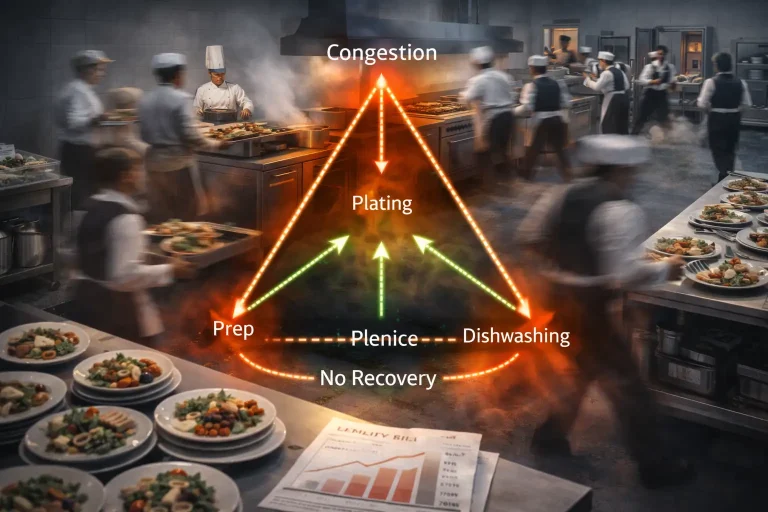
Assumption vs Reality in Oven Selection
Design assumption: Once the oven passes factory testing and commissioning, performance is guaranteed.
Operational reality: During the first full banquet service, protein yield drops, cooking times stretch, ventilation struggles, and service rhythm collapses — even though every checklist was signed.
The oven was commissioned. The menu was approved. The drawings were signed.
Yet under real operational pressure, the kitchen fails.
Across turnkey commercial kitchen projects in Africa, the Middle East, and Europe, this pattern repeats itself. The issue is rarely the chef or the recipe. It is the wrong oven type selected for the menu logic, climate conditions, BOH workflow, and MEP reality.
Choosing between a combi oven and a convection oven is not a culinary preference. It is a project decision that directly affects layout coordination, MEP capacity, commissioning stability, energy load, and long‑term operating cost.
What Exactly Is a Convection Oven? (Dry Heat Logic)
A convection oven uses dry heat combined with high‑speed fans to circulate hot air evenly inside the cavity.
Where Convection Ovens Perform Best
- Pastry & bakery programs
- Viennoiserie, cookies, biscuits
- Pizza bases and dry baking
- Kitchens with limited MEP capacity
Advantages
- Lower initial investment
- Minimal water and drainage requirements
- Simpler electrical load
- Easier maintenance
Limitations
- No humidity control
- Lower yield on proteins
- Limited multi‑stage cooking flexibility
Project insight – Munich Airport Bakery: Switching from combi to convection ovens improved croissant color consistency by 22% due to stable dry‑heat control.
What Exactly Is a Combi Oven? (Steam + Dry Heat Intelligence)
A combi oven combines steam, dry heat, and mixed modes with programmable humidity control and fan‑speed management.
Where Combi Ovens Excel
- Hotels and resort kitchens
- Banquet & buffet operations
- Central production kitchens
- Protein‑heavy menus
Advantages
- 15–20% higher yield on proteins
- 25–30% faster cooking cycles
- Superior moisture retention and consistency
- Reduced chef dependency for complex dishes
Limitations
- Higher CAPEX
- Requires filtered water inlet and drainage
- Three‑phase power dependency
- Training required (often included with Turkey‑built units)
Project insight – Istanbul Convention Center: Combi ovens reduced protein shrinkage by 18%, generating approximately €2,700 monthly savings.
Why the Wrong Oven Becomes a Project Risk
In project environments, oven selection affects far more than cooking quality.
An oven is not an isolated appliance — it is a system driver that influences layout coordination, MEP sizing, installation sequencing, and commissioning logic.
When the wrong oven type is selected, problems rarely appear during factory testing or initial handover. They emerge under real operational pressure — during full banquet service, peak hours, and simultaneous cooking cycles.
A mismatched oven choice can trigger a chain reaction:
- Ventilation systems become oversized or undersized when steam and heat loads are miscalculated.
- Water treatment systems are specified incorrectly, leading to scale formation or sensor failures.
- Drainage slopes fail under live steam discharge, causing commissioning delays or hygiene risks.
- BOQ revisions appear late, forcing variations during installation instead of controlled design-stage decisions.
- Commissioning timelines stretch as systems are adjusted on site rather than validated as a whole.
We saw hotel projects where combi ovens were installed without finalized drainage coordination, forcing last-minute civil works after equipment placement. In other cases, convection ovens were selected for high-volume banquet kitchens, resulting in protein yield loss, extended service time, and staff fatigue.
Key takeaway:
The oven decision defines system behavior. When selected incorrectly, it destabilizes ventilation, MEP coordination, commissioning flow, and long-term operational stability — even if the equipment itself performs as specified.
Head‑to‑Head Comparison (Project Perspective)
Feature | Combi Oven | Convection Oven |
Heat logic | Steam + dry | Dry only |
Menu flexibility | Very high | Moderate |
Protein yield | +15–20% | Lower |
Ideal use | Hotels, banquets, CP kitchens | Bakery & pastry |
Energy efficiency | High in mixed menus | High in pastry‑focused menus |
MEP complexity | Medium–high | Low |

Menu Logic – The Real Decision Maker
Choose Convection Ovens If:
- Pastry exceeds 30% of the menu
- Bakery output is daily and consistent
- Low OPEX and simplicity are priorities
- Space and infrastructure are limited
Choose Combi Ovens If:
- Proteins dominate the menu
- Banquets and buffets are frequent
- Menu variety is high
- Yield control matters
Kenya business hotel case: Convection ovens caused 14–18% protein shrinkage on chicken breasts. Switching to combi ovens stabilized yield and service timing.
How Oven Selection Impacts Installation & Commissioning
In commercial kitchen projects, installation and commissioning success is closely tied to oven selection — yet this relationship is often overlooked during design and procurement.
Different oven types impose different installation realities.
Convection ovens typically allow earlier installation due to lighter MEP requirements, minimal drainage coordination, and simpler commissioning procedures. This makes them more forgiving in projects with tight schedules or limited infrastructure readiness.
Combi ovens, however, demand precise sequencing.
Water inlet, drainage slope, ventilation capture, electrical stability, and control calibration must be aligned before commissioning can succeed. When these dependencies are underestimated, projects experience late-stage failures — not because the oven is faulty, but because the system around it is incomplete.
Common installation and commissioning risks linked to oven selection include:
- Equipment installed before drainage and water treatment are finalized
- Steam discharge conflicting with hood performance
- Commissioning performed under partial load instead of real service conditions
- Temporary bypasses becoming permanent operational weaknesses
In several hotel projects, combi ovens passed dry testing and initial commissioning but failed during the first live banquet service, when steam, ventilation, and power loads peaked simultaneously.
Project insight:
An oven that works during testing but fails during service is not a product problem — it is a sequencing and coordination failure.
Successful projects treat oven selection as an installation strategy decision, not just a cooking technology choice.
Consultant Assumption vs Operational Reality
Design assumption: One oven type can serve all menu scenarios.
Operational reality: Climate, humidity, service simultaneity, and workflow intensity dictate oven behavior.
Approved layouts rarely simulate peak banquet loads, simultaneous cooking lines, or humidity stress. This is why oven selection must be validated against real service behavior, not theoretical capacity.
Climate‑Zone Impact on Oven Performance
Tropical Africa
- High humidity stresses dry baking
- Scale‑formation risk for steam systems
- Voltage‑fluctuation tolerance is critical
Middle East
- Hard water damages steam generators
- Drain‑slope errors cause steam blowback
- Combi ovens become mandatory beyond 600 covers
Europe
- Lower ambient temperatures favor combi recovery
- Noise control and energy regulation dominate
- Convection dominates pastry‑heavy concepts
MEP Integration – The Hidden Cost Driver
Convection Oven MEP Profile
- Light electrical load
- No drainage
- Basic ventilation
Combi Oven MEP Profile
- Filtered water inlet
- Drain with 1–1.5% slope
- Stable three‑phase power
- Hood with steam capture
Dubai airport catering case: Incorrect drain slope delayed commissioning by 3 days, costing approximately $6,000 in corrections.
ROI‑Driven Oven Selection Matrix
Factor | Convection | Combi | Best fit |
Protein yield | Low | High | Hotels & catering |
Bakery quality | High | Medium | Pastry kitchens |
Energy efficiency | Medium | High | Resorts |
Maintenance | Low | Medium | Mixed menus |
Payback period | 24–30 months | 14–19 months | High‑volume operations |
Turkey‑Built vs Imported Oven Technologies
Turkey‑manufactured ovens now match European engineering standards while offering:
- CE & HACCP compliance
- AISI 304 stainless construction
- Climate‑adaptive steam systems
- Faster spare‑part availability
Lead‑time comparison:
- Turkey‑built: 6–8 weeks
- Imported European brands: 10–14 weeks
In project environments, downtime costs far exceed brand perception.
Final Project Insight
Choosing between a combi oven and a convection oven is not a culinary preference.
It is a project decision that affects layout coordination, MEP integration, installation risk, energy cost, and long‑term operational stability.
In turnkey kitchen projects, the right oven choice protects not only food quality — but the entire system.
In turnkey kitchen projects, oven selection should be validated not only against menu requirements, but against installation sequencing, commissioning behavior, and real operational load. When this validation is missing, even the best equipment fails quietly — after opening, not before.
FAQ – Combi vs Convection
1. Does a combi replace convection fully?
Mostly yes, except in high-end pastry.
2. Which saves more money?
Combi — 15–20% better
3. Which oven is easier to maintain?
Convection.
4. Are Turkish ovens equal to European brands?
Yes — CE-certified and climate-adapted.
5. Which is better for hotels?
Combi — especially for banquets.