Kitchens rarely fail during normal service.
They fail when demand compresses time.
Banquet service exposes weaknesses that daily operations quietly hide. Equipment works. Staff is present. Menus are approved. Yet under banquet pressure, kitchens slow, bottlenecks appear, and recovery collapses.
The issue is not scale.
It is synchronization.
Banquet pressure does not create problems.
It reveals decisions that were never tested under load.
Why Banquet Operations Stress Kitchens Differently Than Daily Service
Banquet operations fail kitchens not by increasing volume, but by forcing multiple processes to peak at the same time with no recovery window.
Daily service spreads demand across time.
Banquets compress it.
Production peaks simultaneously. Holding, plating, dishwashing, and service recovery overlap. Systems that perform well in staggered operation are suddenly required to work in parallel.
Banquet service turns time into the scarcest resource.
The Hidden Assumption: Kitchens Are Designed for Average Load
Most commercial kitchens are designed for average, sequential demand, not for fully synchronized peak operation.
Most kitchens are designed around average operational flow.
Layouts assume sequential use. Equipment is sized for typical cycles. Staffing models expect rotation.
Under banquet pressure, these assumptions collapse.
Multiple processes demand the same space, power, ventilation, and access at the same moment. The kitchen does not break — it slows.
Where Banquet Failures Actually Begin
Banquet failures start upstream in prep, holding, and recovery zones long before problems appear at the service pass.
Failures rarely start at the pass.
They start upstream:
- Prep areas become congested
- Holding capacity is insufficient or poorly positioned
- Plating zones lack clearance
- Dishwashing recovery overlaps with peak production
Each issue is manageable alone.
Together, they overwhelm the system.
Banquet vs À La Carte: Why the Same Kitchen Behaves Differently
The same kitchen behaves differently because banquet service removes time buffers that normally absorb inefficiencies in à la carte operations.
À la carte service distributes demand over time.
Orders arrive in waves. Production cycles reset naturally. Equipment recovers between peaks.
Banquet service removes this buffer.
Production starts together. Holding fills at once. Plating accelerates simultaneously. Dishwashing and recovery overlap with service execution.
The kitchen is not asked to work harder.
It is asked to work at the same time.
Energy and Ventilation Peak Overlap Under Banquet Load
Banquet service creates energy inefficiency by forcing ventilation, cooking, refrigeration, and dishwashing systems to peak simultaneously.
Banquet service creates simultaneous energy peaks.
Cooking equipment, ventilation systems, refrigeration recovery, and dishwashing often reach maximum demand together.
Under daily service, these systems peak separately.
Under banquet pressure, they collide.
Energy stress is not caused by inefficient equipment.
It is caused by synchronized runtime.
A Real-Life Banquet Timeline Breakdown
Banquet timelines compress hours of preparation, production, and recovery into minutes, leaving no margin for error.
A typical banquet service compresses hours of activity into minutes.
- T-120 min: Preparation starts early, equipment powered on
- T-60 min: Cooking ramps up across all sections
- T-30 min: Holding reaches capacity
- Service start: Plating peaks, ventilation reaches maximum
- +15 min: Dishwashing overlaps with service
- +30 min: No recovery window remains
Small delays have no space to dissolve.
Once the timeline compresses, control disappears.
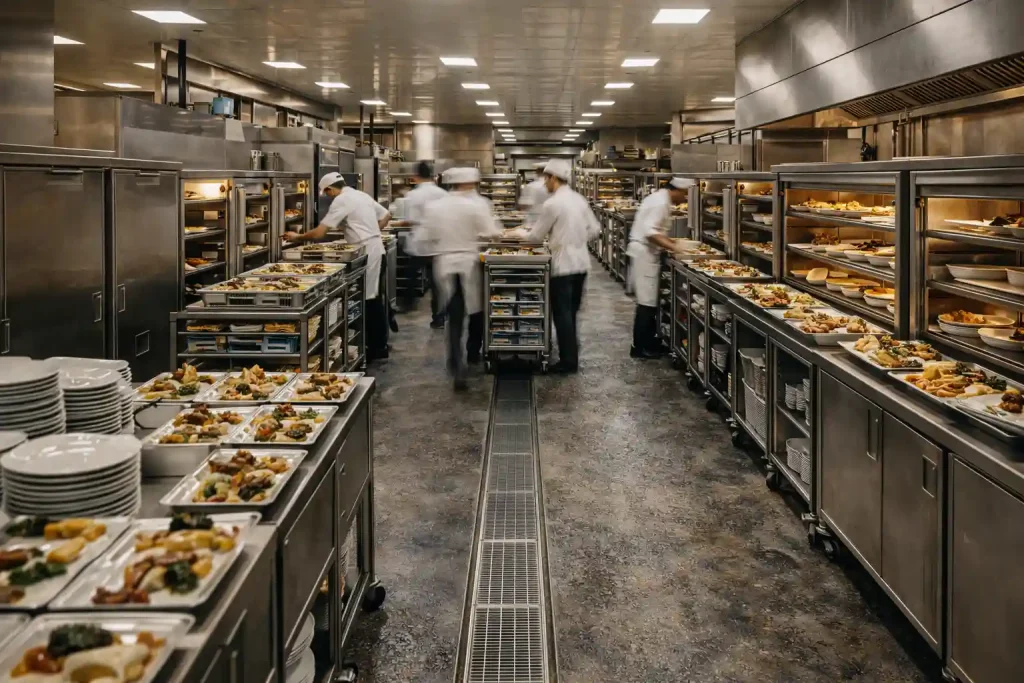
Workflow Compression and the Loss of Recovery Time
When workflows compress under banquet pressure, kitchens lose recovery time, which is essential for maintaining control.
Banquet kitchens lose the ability to recover between tasks.
Equipment remains active longer. Staff waits instead of moves. Small delays stack without space to absorb them.
Recovery time disappears — and with it, control.
BOQ Decisions That Fail Under Banquet Load
BOQs fail under banquet load because they define capacity without testing how systems behave simultaneously.
BOQs often reflect equipment counts, not simultaneous behavior.
They list capacity without testing overlap. Holding, cooking, ventilation, and power demands are treated independently.
Under banquet load, these systems peak together.
This is not under-sizing.
It is under-coordination.
Why Recovery Failure, Not Capacity, Breaks Banquet Kitchens
Banquet kitchens fail not from lack of capacity, but from the inability to reset systems and workflows between peaks.
Most banquet kitchens do not fail because equipment capacity is insufficient.
They fail because recovery is impossible.
When multiple systems peak together, there is no time to reset. No buffer to absorb delays. No opportunity for systems or staff to recover.
Capacity exists.
Control does not.
This is why adding equipment or staff after opening rarely fixes banquet problems. Recovery time cannot be installed retroactively.
Why Banquet Stress Permanently Changes Kitchen Behavior
Repeated banquet pressure permanently shifts kitchen behavior toward earlier starts, higher holding, and reduced recovery tolerance.
Banquet service may be occasional.
Its operational impact is not.
After repeated banquet pressure, kitchens adapt:
- Equipment is powered on earlier as a precaution
- Holding volumes increase permanently
- Additional staff become normalized
- Recovery expectations shrink
What begins as a temporary response becomes standard operation.
Banquet pressure leaves behavioral residue.
And that residue rewrites performance long after the event ends.
The Costly Fixes Kitchens Try After Banquet Failure
Post-opening fixes address symptoms of banquet failure but rarely resolve the design decisions that caused it.
Once banquet performance disappoints, most kitchens attempt the same corrections:
- Add more staff during events
- Increase holding capacity
- Start preparation earlier
- Oversize ventilation or cooling systems
These actions feel logical.
They are also expensive.
They do not remove the cause.
They compensate for it.
Banquet problems solved operationally almost always return — carrying higher labor, energy, and stress costs.
The Turnkey Lens: Designing for Peak Synchronization
Turnkey delivery protects banquet performance by validating system synchronization before installation locks behavior in place.
A turnkey approach evaluates kitchens at their most stressed moment.
Instead of asking whether equipment meets capacity, it asks whether systems can operate together without blocking each other.
Manufacturing feedback helps align production sequences. Layouts are tested for simultaneous movement. Critical systems are stabilized through precision-driven integration where tolerance is low.
Banquet pressure is treated as a design condition, not an exception.
What Banquet Failure Looks Like After Opening
After opening, banquet failure appears as slower service, higher energy use, and permanent operational stress rather than visible breakdowns.
Service does not collapse completely.
It slows.
Staff compensates.
Guests wait longer.
Energy use spikes.
Stress replaces rhythm.
The kitchen survives.
But performance erodes.
Where Most Banquet Kitchens Go Wrong
Most banquet kitchens fail by assuming daily-service performance will scale temporarily under peak pressure.
Banquet failure is rarely caused by one missing element.
It comes from assuming that what works daily will scale temporarily.
Banquet pressure does not forgive average design.
Why This Matters Before Installation
Banquet performance must be designed before installation because layouts, utilities, and workflows cannot be reshaped later.
Banquet stress cannot be fixed easily after opening.
Layouts are fixed. Utilities are committed. Workflows are learned.
Designing for peak synchronization before installation protects performance when pressure is highest.
The Moment Banquet Performance Becomes Non-Negotiable
Once installation is complete, banquet performance can only be absorbed operationally, not redesigned structurally.
Once installation is complete, banquet performance is no longer adjustable through design.
From that point onward, kitchens can only absorb pressure — not reshape it.
The most resilient banquet kitchens are not those with more equipment.
They are the ones designed to survive simultaneous demand.
FAQ — Banquet Pressure and Commercial Kitchens
Why do kitchens fail during banquets but not daily service?
Because banquet service compresses multiple processes into the same time window, eliminating recovery and tolerance.
Is banquet failure mainly a staffing problem?
No. Staffing compensates for design limitations but cannot remove synchronized bottlenecks.
Can banquet performance be improved after opening?
Only partially, and usually at high operational cost.
Does larger equipment solve banquet issues?
Not without workflow, sequencing, and system coordination.
When should banquet stress be addressed?
During design, before layouts, BOQs, and installation decisions are locked.