Why the Lowest CAPEX Rarely Survives the First 12 Months
Nothing dramatic happens when ROI starts leaking.
Kitchens adapt. Teams adjust. Extra steps become routine. What was supposed to be temporary slowly becomes permanent.
The kitchen still operates. Service continues. Guests rarely notice anything wrong. Yet month by month, the return on investment quietly shifts.
Not because something failed.
But because ROI was measured too early.
Across hotel and resort kitchens, we repeatedly observe this pattern. Equipment specifications are correct. Drawings are approved. Installation is completed. On paper, the project looks successful.
ROI does not collapse at opening.
It erodes quietly, once operations begin.
Turnkey commercial kitchen projects are not about paying more upfront.
They are about locking ROI before daily behavior starts rewriting it.
Why Kitchen ROI Is Usually Measured Wrong
Most kitchen projects treat ROI as a procurement outcome.
If equipment stays within budget, installation finishes on time, and commissioning is signed off, ROI is considered achieved.
But commercial kitchens do not generate return at handover.
They generate return during:
- Peak service pressure
- Staff rotation and learning cycles
- Energy recovery and load balancing
- Post-opening operational reality
A kitchen that opens cheaper but operates inefficiently produces negative ROI disguised as normal operations.
Key insight: ROI is not a procurement metric.
It is an operational outcome that unfolds over time.
ROI Is Not a Number — It Is a Timeline
ROI behaves differently at each project phase.
Understanding this timeline determines whether ROI is protected or allowed to leak.
- Design phase: ROI can be protected cheaply. Assumptions are still flexible.
- Pre-installation: ROI can still be locked through sequencing and validation.
- Installation: ROI leakage begins as decisions harden.
- Soft opening: Behavioral patterns start forming.
- First peak season: Inefficiencies either stabilize or multiply.
Turnkey projects focus on fixing problems at the earliest and cheapest moment — before the kitchen starts earning money.
Once the project passes into live operation, ROI discussions become reactive.
By then, recovery is never cheap.
How Daily Kitchen Behavior Slowly Rewrites ROI
ROI rarely disappears through one visible failure.
It shifts through small, repeated behaviors.
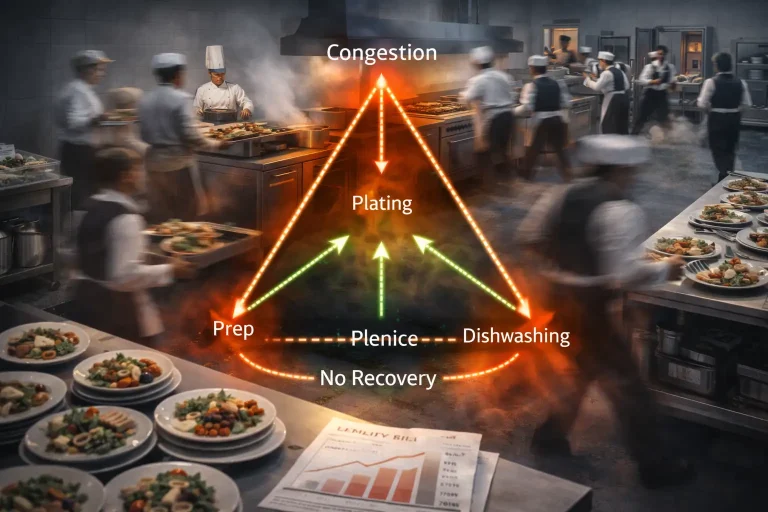
Preparation starts earlier because workflows feel tight. Peak hours take longer to recover. Staff develop informal shortcuts to maintain service flow. Supervisors remain closer to operations than originally planned.
Each adjustment feels practical.
None feel expensive.
Yet every adaptation carries cost.
Extra minutes turn into additional labor hours. Temporary fixes solidify into permanent routines. Energy systems run longer to stabilize timing gaps.
Over time, the kitchen adapts — and ROI adapts with it.
By the time performance is reviewed financially, the behavior is already normalized.
The KPIs That Look Healthy While ROI Is Bleeding
Many kitchens appear successful while ROI quietly erodes.
Opening dates are met. Food cost ratios remain acceptable. Guest satisfaction stays stable.
Yet beneath these indicators:
- Labor cost increases quarter by quarter
- Energy consumption exceeds modeled assumptions
- Management time shifts from optimization to control
The issue is not lack of data.
It is tracking indicators that reflect delivery, not performance.
The Hidden ROI Killers in Non-Turnkey Projects
Once ROI moves from paper to operation, leakage becomes predictable.
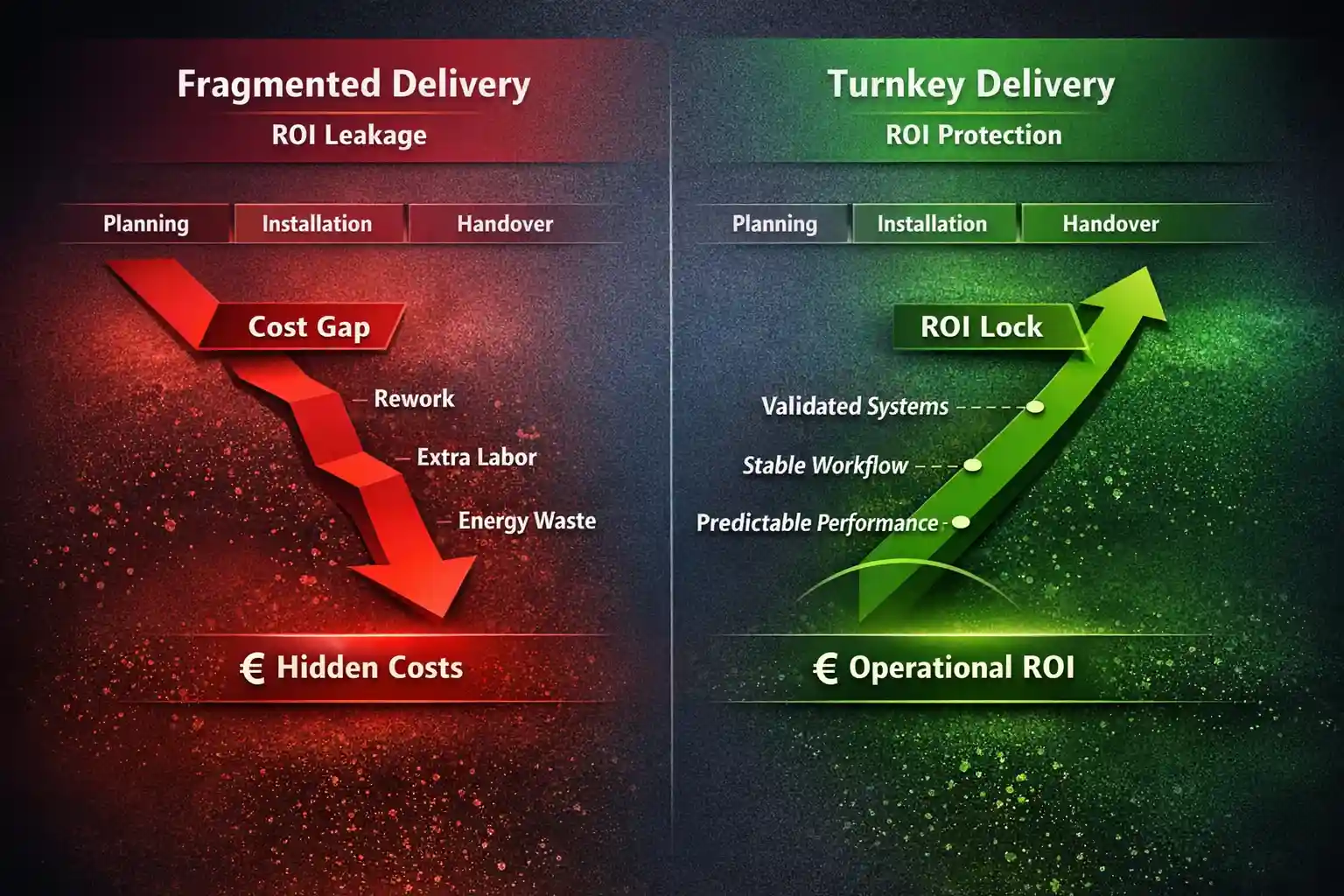
In fragmented delivery models, the same pressure points appear repeatedly:
- Installation rework from late-discovered layout conflicts
- Labor inflation driven by workflow friction
- Energy waste from oversized systems compensating for timing gaps
- Management overhead focused on stabilizing instability
Each issue seems operational on its own.
Together, they quietly destroy ROI.

Why BOQs Protect Budget — But Not ROI
BOQs are designed to protect scope and price.
They are not designed to protect behavior.
A BOQ can be technically accurate and still allow ROI erosion.
Missing drains, incorrect clearances, or unlisted support frames may appear minor on paper.
On site, these issues trigger resequencing, rework, retesting, and delayed stabilization.
This is not a BOQ problem.
It is an ROI erosion mechanism.
A €5,000 correction before installation routinely becomes a €30,000–€40,000 operational cost once the kitchen is live — simply because timing was missed.
The Moment ROI Becomes Irreversible
Every project reaches a point where ROI decisions harden.
Equipment is installed. Interfaces are fixed. Staff workflows stabilize.
After this point, improvement remains possible — but recovery is never cheap.
Most ROI discussions begin after this moment, which is why they fail.
A Familiar Scenario
Consider a high-volume hotel kitchen opening with a tight service window.
The layout technically works, but recovery between peaks feels slow. An extra prep position is added. Energy systems run longer to maintain timing. Supervisors remain on the floor to manage flow.
Nothing breaks.
Everything functions.
Six months later, the kitchen requires more staff than planned and consumes more energy than modeled.
ROI was not lost through failure.
It was rewritten through adaptation.
Where ROI Is Actually Lost After Opening
Post-opening fixes rarely inflate CAPEX.
They inflate OPEX permanently.
Labor-Driven ROI Erosion
Labor grows to compensate for friction. Staffing increases feel operationally justified, then become permanent.
Energy-Driven ROI Erosion
Energy systems run longer and harder to stabilize timing gaps created by workflow inefficiencies.
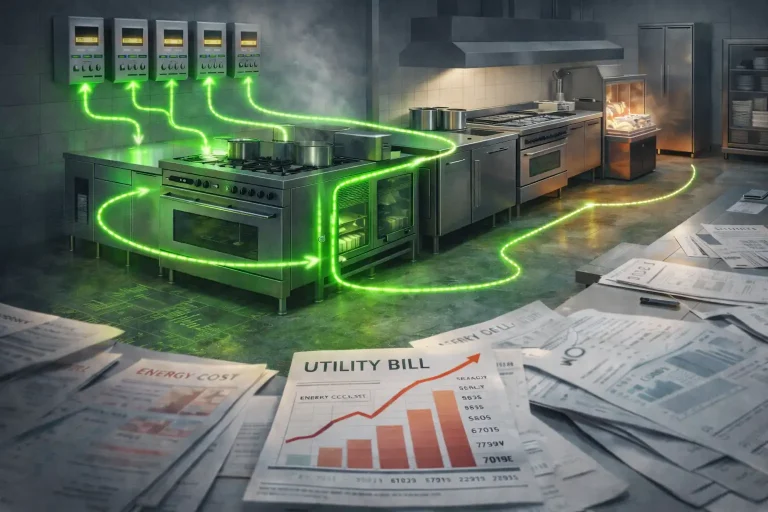
These costs do not appear in project documents.
They appear in monthly P&Ls.
Turnkey Lens — Where ROI Is Actually Protected
Turnkey is not about one contract.
It is about one party owning outcomes.
A turnkey mindset:
- Engineers workflow instead of reacting to staff behavior
- Tests systems under real pressure
- Anticipates operational reality
- Owns performance after opening
A manufacturer-led turnkey structure enables this control.
Turkey-built execution allows faster correction, tighter sequencing, and lower long-term operational risk.
Made in Turkey is not just origin.
It is execution speed, adaptability, and accountability.
Why Most ROI Discussions Start Too Late
Most ROI conversations happen after opening — when behavior is already locked.
By then, cost is no longer adjustable through design.
It can only be absorbed through operation.
True ROI strategy begins before installation.
That is where irreversible cost can still be prevented.
Why ROI Is Decided Before the First Service
Turnkey commercial kitchen projects do not deliver higher ROI because they cost less.
They deliver higher ROI because they prevent irreversible operational cost.
The real return is not saved at procurement.
It is protected before installation — and proven after opening.
FAQ — ROI & Turnkey Commercial Kitchen Projects
Is turnkey always more expensive upfront compared to multi-supplier delivery?
Not necessarily. While turnkey projects may show a slightly higher initial CAPEX in some cases, this difference is often offset — and exceeded — by lower labor, energy, and management costs during the first 6–12 months of operation.
Can ROI losses be realistically fixed after a kitchen is already operating?
Only partially. Once workflows, staffing levels, and operating habits stabilize, improvements become incremental and costly. Most ROI recovery actions after opening address symptoms, not root causes.
Why does labor become the fastest-growing ROI leak in commercial kitchens?
Because workflow inefficiencies and recovery delays translate directly into permanent staffing decisions. What begins as temporary support during opening often becomes embedded headcount.
How does turnkey delivery protect ROI beyond installation and commissioning?
By keeping technical authority, manufacturing feedback, and execution responsibility aligned after opening. This allows early operational friction to be corrected before it hardens into permanent cost.
At what stage should ROI-driven decisions actually be made?
Before installation begins — ideally during design freeze and pre-installation validation — when sequencing, interfaces, and behavior can still be shaped at minimal cost.