Most kitchen layouts look correct on drawings.
Equipment fits. Clearances comply. Distances are measurable. Yet once service begins, movement slows, collisions increase, and pressure concentrates in unexpected zones.
The problem is rarely equipment placement alone.
It is the absence of service flow logic.
When layout ignores how food, staff, and equipment actually move during live service, kitchens do not fail immediately.
They degrade.
Why Service Flow Fails Even When Workflow Looks Efficient
A kitchen can follow a perfect workflow on paper and still struggle the moment service starts.
Workflow describes tasks.
Service flow describes movement.
Many kitchens optimize workflow — prep, cook, plate, wash — without validating how people, trays, carts, and waste circulate between these steps under live pressure.
A workflow can be efficient in isolation while service flow collapses in reality.
Flow problems appear only when time compresses.
The Illusion of Clearance Compliance in Kitchen Layouts
Many layouts comply fully with clearance standards.
Compliance, however, does not guarantee flow.
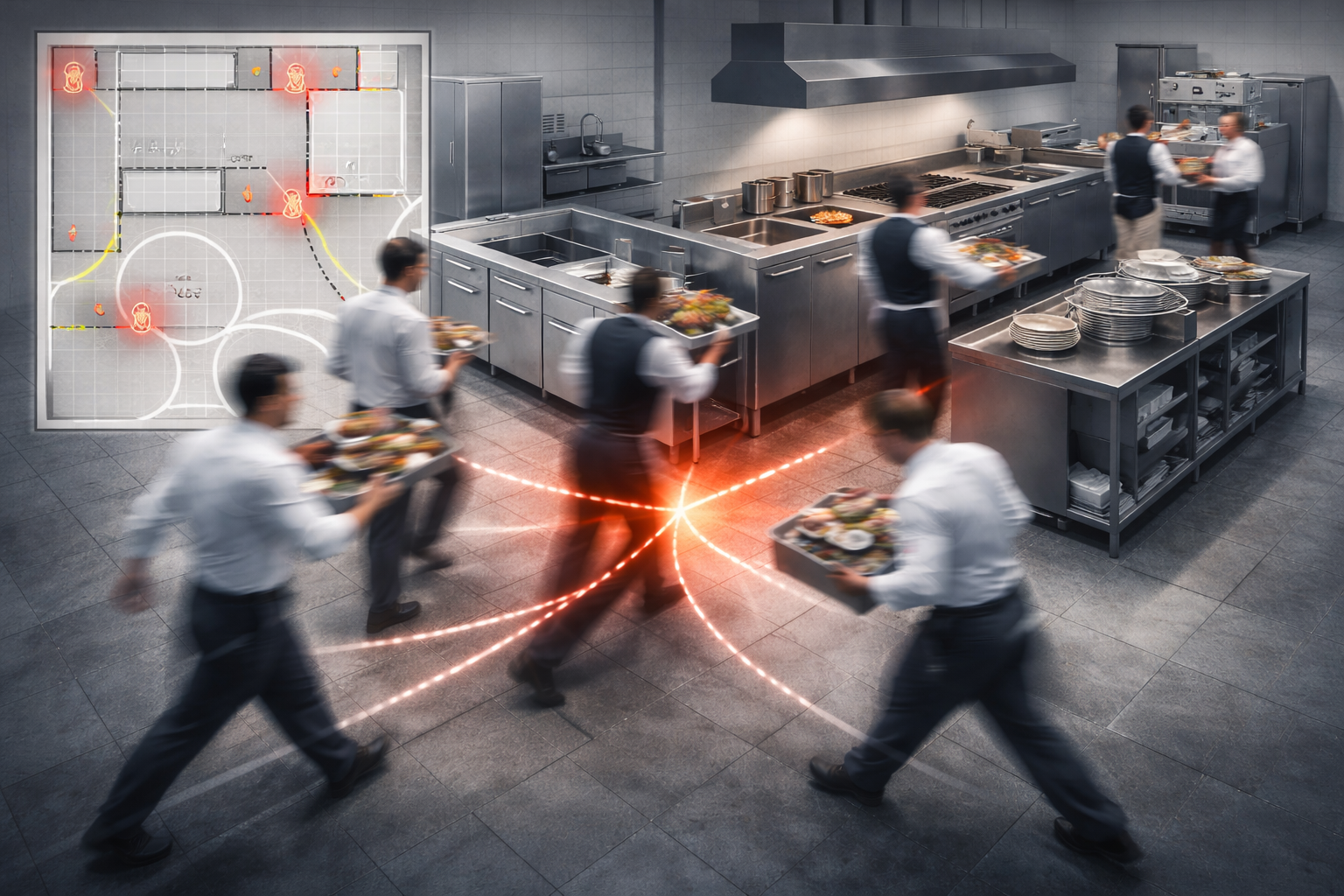
A corridor may meet minimum width requirements and still choke movement when carts, hot trays, and staff converge simultaneously.
Clearance is static.
Service flow is dynamic.
Layouts designed only for static compliance often fail once movement becomes continuous.
Where Layout Decisions Quietly Block Service Flow
Service flow rarely breaks in open areas.
It fails at transitions.
Typical pressure points include:
- Between hot production and plating
- Between pass and service exit
- Between dirty return and dishwashing
- Between storage and prep during peak periods
Each transition introduces friction when visibility, clearance, or directional priority is underestimated.
No single blockage looks critical.
Together, they slow the entire system.
Why Congestion Persists Even With Adequate Staffing
Congestion is often blamed on poor discipline or insufficient staffing.
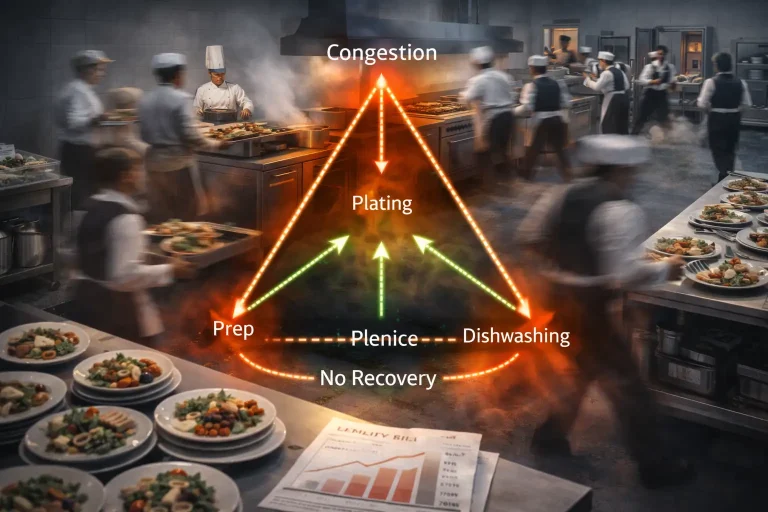
In reality, congestion emerges when multiple movement paths cross without hierarchy.
Staff hesitate.
Movements slow.
Micro-delays multiply.
Congestion is not caused by people.
It is caused by layouts that never defined which movement has priority during peak moments.
Service Flow–Driven Layout vs Equipment-Centric Layout
The difference between layouts that survive peak service and those that struggle is rarely equipment capacity.
It is how movement is structured.
Aspect | Equipment-Centric Layout | Service Flow–Driven Layout |
Primary design focus | Equipment fit and clearances | Movement hierarchy and circulation |
Design validation | Static drawings and code checks | Live service and peak movement scenarios |
Congestion management | Absorbed by staff behavior | Removed structurally through layout |
Peak service performance | Degrades under compression | Stabilizes under load |
Labor impact | Compensatory staffing | Predictable staffing levels |
Energy behavior | Extended runtime across systems | Controlled runtime with recovery windows |
Post-opening fixes | Workarounds and shortcuts | Minimal operational adjustment |
Layouts optimized only for equipment often depend on people to fix flow.
Layouts optimized for service flow remove friction before it reaches staff.

Why Peak Service Compresses Movement and Breaks Flow
During peak service, time becomes the scarcest resource.
Multiple paths converge simultaneously:
- Hot food moving to pass
- Service staff returning with empty trays
- Dishwashing intake beginning early
- Last-minute prep access
When these paths intersect without hierarchy, hesitation replaces rhythm.
Flow does not break because staff move incorrectly.
It breaks because paths collide.
The First 30 Minutes of Service: Where Flow Is Exposed
Flow does not fail gradually.
It fails immediately.
During the first 30 minutes:
- Production accelerates
- Service staff returns simultaneously
- Dishwashing intake starts early
If paths intersect without priority, hesitation replaces rhythm.
Small pauses compound quickly.
À La Carte vs Banquet: Why the Same Kitchen Behaves Differently
À la carte service distributes demand.
Banquet service compresses it.
Under à la carte conditions, inefficiencies dissolve between waves.
Under banquet pressure, there are no recovery windows.
Layouts that tolerate daily variability often collapse when demand becomes simultaneous.
How Poor Flow Quietly Increases Labor Cost
When flow slows, labor compensates.
Extra hands are added temporarily.
Supervisors stay on the floor longer.
Support roles become permanent.
What begins as operational support turns into fixed headcount.
Flow problems rarely appear as labor issues on opening day.
They surface gradually in payroll reports.
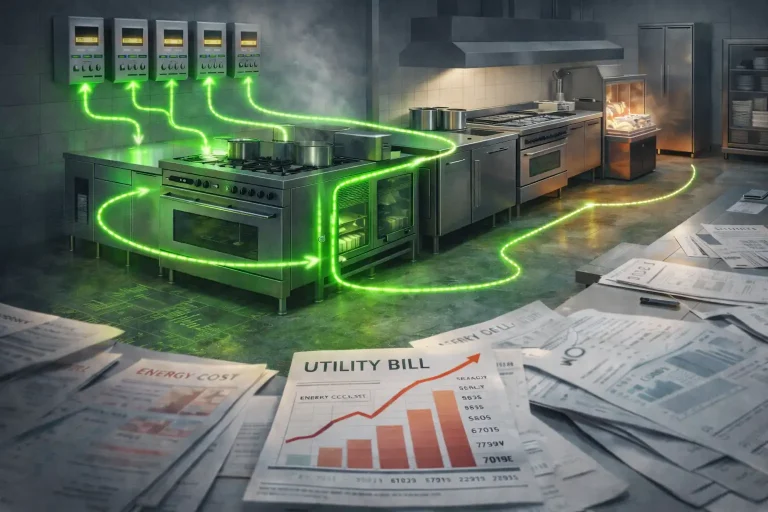
Why Flow Problems Extend Equipment Runtime and Energy Cost
Poor flow changes behavior.
Equipment is powered on earlier.
Systems remain active between peaks.
Recovery windows disappear.
Energy cost rises not because equipment is inefficient, but because runtime expands.
Flow issues silently rewrite energy behavior.
When Flow Problems Increase Safety Risk and Staff Fatigue
Intersecting paths do more than slow service.
They increase risk.
Hot trays, sharp tools, and carts move through shared corridors.
Visibility drops.
Reaction time shrinks.
Staff fatigue rises not because of workload, but because movement lacks rhythm.
Safety margins erode quietly.
Why Flow Problems Don’t Appear in Design Reviews
Service flow rarely fails design reviews.
Drawings are static.
Movement is not.
Design checks validate dimensions, compliance, and equipment fit.
They do not test movement under pressure.
A layout can pass every review and still collapse during service.
What Flow Failure Looks Like After Opening
Kitchens open successfully.
Service continues.
Yet shortcuts appear.
Informal routes form.
Stress replaces rhythm.
The layout survives.
Performance drifts.
Why Flow Problems Become Cultural After Opening
Once a kitchen adapts to poor flow, the adaptation becomes culture.
Shortcuts turn into habits.
Informal routes become accepted paths.
New staff are trained around the layout instead of questioning it.
At this stage, layout-driven inefficiency is no longer visible — but it is fully costed.
Engineering Service Movement Before Installation Begins
A turnkey approach evaluates layout behavior, not just geometry.
Movement simulations, peak overlap analysis, and recovery sequencing are tested early.
Manufacturing-led feedback allows repositioning before anchoring points are fixed.
Integrated execution stabilizes zones where tolerance is minimal.
Flow is engineered early — not improvised later.
Why This Must Be Solved Before Installation
Service flow cannot be fixed cheaply after opening.
Walls are built.
Utilities are fixed.
Habits harden quickly.
Designing for flow before installation protects speed, safety, and service quality when pressure is highest.
What This Really Means for Decision-Makers
Service flow is not a comfort issue.
It is a performance control issue.
Layouts that ignore movement under pressure transfer responsibility from design to people.
Layouts that respect service flow remove friction before it reaches staff.
The difference is not aesthetic.
It is economic, operational, and cultural.
FAQ – Kitchen Layout and Service Flow
Why do kitchens feel crowded even when they meet clearance standards?
Because compliance measures space statically, while service flow depends on simultaneous movement under pressure.
Is service flow the same as workflow?
No. Workflow defines tasks; service flow defines how people, food, and equipment move between those tasks.
Can service flow be improved after opening?
Only partially, and usually through operational workarounds rather than structural correction.
Does more space automatically solve flow issues?
No. Directional hierarchy and movement priority matter more than raw square meters.
When should service flow be validated?
Before installation, under simulated peak service conditions where recovery windows disappear.