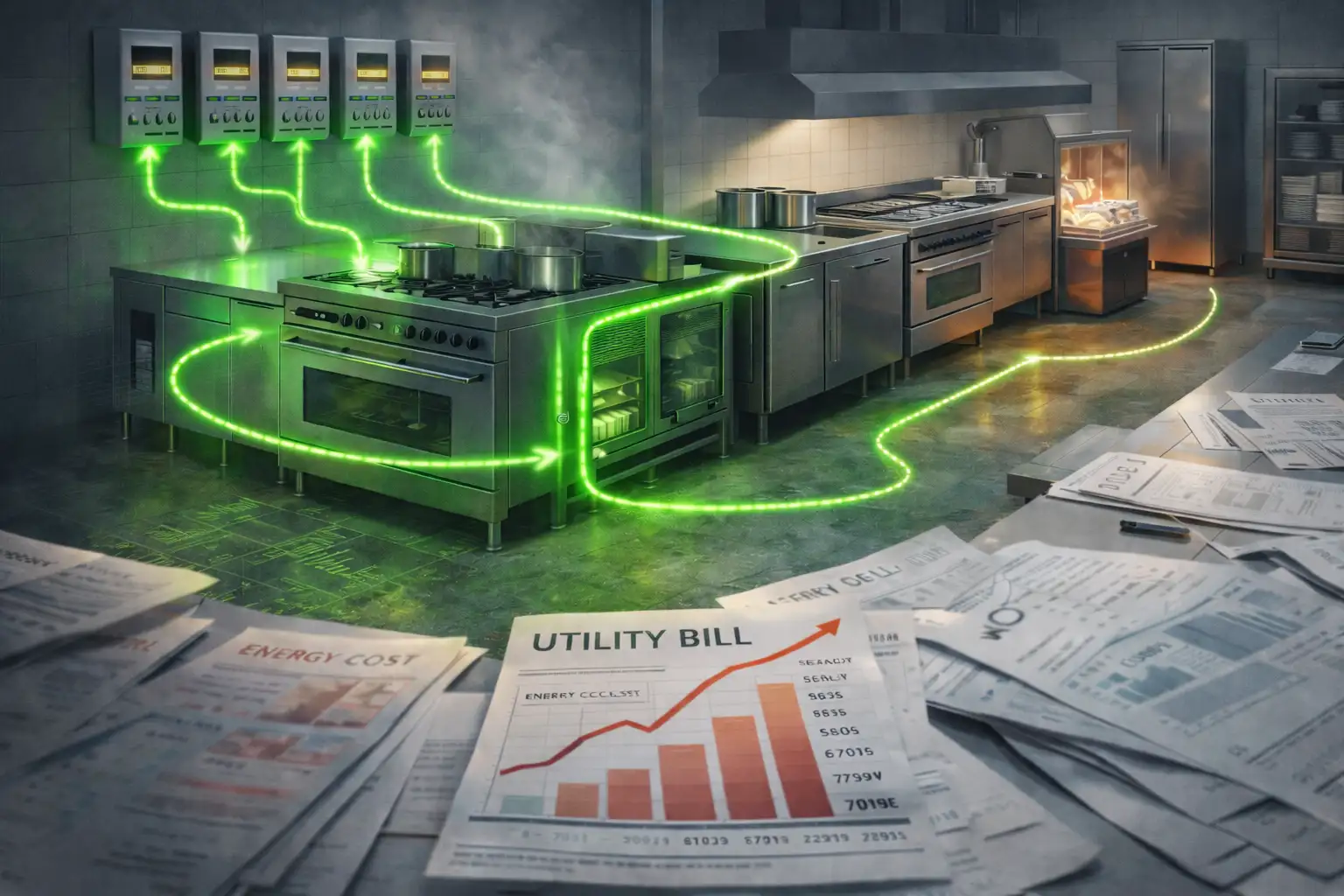
Nothing is technically wrong when energy bills start rising.
Kitchens adapt. Teams adjust. Extra steps become routine. What was supposed to be temporary slowly becomes permanent.
Equipment works. Systems comply. Utility meters spin exactly as designed. Yet month by month, operating costs drift upward, often faster than forecast.
In most commercial kitchens, energy problems are blamed on inefficient equipment or rising utility prices. In reality, energy starts leaking much earlier — at the design table. Long before equipment is switched on, certain design decisions quietly lock systems into longer runtimes, overlapping peaks, and unnecessary load.
This is not an efficiency problem.
It is a design behavior problem.
Why Energy Problems Start at Design, Not Equipment
Energy costs are largely determined by design decisions that control system runtime, overlap, and sequencing—long before equipment efficiency becomes relevant.
Most kitchens focus on equipment efficiency ratings when evaluating energy use. While efficiency matters, it rarely determines how long systems run.
Runtime is dictated by design.
Ventilation zoning defines how long exhaust fans operate. Refrigeration layouts determine compressor cycling. Cooking line sequencing controls how many systems peak at the same time. These factors are decided during layout coordination, not during procurement.
When design prioritizes installation simplicity over operational rhythm, systems compensate by running longer.
This is why energy discussions focused only on efficiency ratings almost always disappoint.
Two kitchens with identical equipment can consume radically different amounts of energy simply because one was designed to limit runtime, while the other was designed to tolerate it.
Design does not change how efficient a system is — it decides how often and how long that system must work.
Design Decisions That Force Systems to Run Longer
Seemingly compliant layout and coordination choices often lock kitchens into extended system runtimes that permanently increase energy consumption.
Many kitchens are not inefficient.
They are designed to stay on longer than necessary.
The following design choices rarely look wrong on drawings, yet they consistently push energy consumption upward after opening.
Ventilation Design That Ignores Real Cooking Demand
Primary energy driver caused by oversized zoning and extended fan runtime.
Oversimplified ventilation zoning forces exhaust systems to operate far longer than actual cooking activity requires, quietly driving energy waste.
Ventilation systems are often designed around maximum capacity instead of actual cooking behavior.
Large hoods cover multiple zones with a single exhaust logic. Fans are sized safely, controls are simplified, and zoning is reduced to avoid coordination effort. On paper, everything complies.
In operation, this means exhaust runs at full or near-full capacity even when only part of the line is active.
Ventilation does not consume energy because it is powerful.
It consumes energy because it runs longer than demand requires.
When zoning and demand-based control are missing, kitchens pay for air movement that no longer serves production.
Refrigeration Layouts That Fight Heat Instead of Avoiding It
Thermal interaction errors that force compressors into constant recovery cycles.
Poor spatial coordination exposes refrigeration systems to constant thermal load, increasing recovery cycles and energy use without any technical fault.
Refrigeration energy loss often starts with placement, not compressor efficiency.
Cold rooms positioned next to cooking lines, bakery ovens, or dishwashing heat zones absorb continuous thermal load. Doors open more frequently because workflows cross hot areas. Recovery cycles lengthen under service pressure.
None of this is a technical failure.
Refrigeration consumes energy when it is forced to recover repeatedly, not when it is poorly built.
Designs that ignore thermal interaction quietly lock refrigeration systems into permanent recovery mode.
Dishwashing Layouts That Turn Intermittent Loads into Continuous Runtime
Batch flow misalignment converting peak loads into permanent energy use.
When dishwashing flow is misaligned with service rhythm, machines shift from batch operation to continuous runtime, inflating energy cost.
Dishwashing areas are commonly designed for peak throughput without considering loading rhythm.
When dishwashers are placed far from collection points or separated from service flow, racks arrive irregularly. To avoid delays, machines are left running between batches.
What should be short, high-intensity cycles become long, low-efficiency operation.
Dishwashing energy waste comes from idle runtime, not wash power.
Once staff adapt to this behavior, runtime expands permanently.
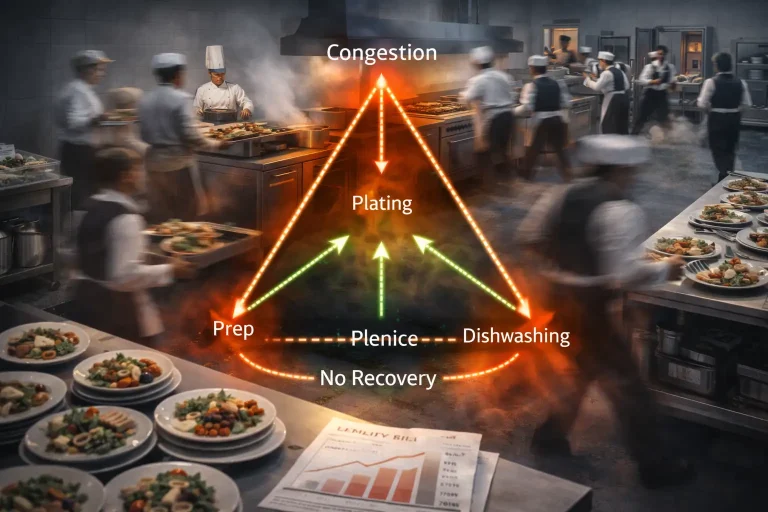
The Compounding Effect Across Systems
Energy costs escalate fastest when ventilation, refrigeration, cooking, and washing systems are designed to peak simultaneously rather than sequentially.
Each of these design decisions may seem manageable on its own.
Together, they synchronize inefficiency.
Ventilation runs longer, often without anyone noticing.
Refrigeration struggles to recover once service pressure builds.
Dishwashing, meanwhile, stays active between peaks almost by habit.
Energy cost does not spike suddenly.
It stretches quietly as runtime overlaps across systems.
The critical issue is not that systems consume energy independently.
It is that poorly coordinated designs force them to consume energy simultaneously.
Once ventilation, refrigeration recovery, cooking, and dishwashing overlap in time, energy cost stops behaving additively and starts behaving exponentially — even though no single system appears oversized or faulty.

Workflow Friction Equals Longer Runtime
Layout-induced behavioral patterns that expand daily system operating hours.
Misaligned workflows cause staff to activate equipment earlier and keep systems running longer, turning design friction into permanent energy behavior.
When workflow is not aligned with physical layout, staff compensate with time.
Preparation starts earlier. Equipment is switched on sooner “just in case.” Systems remain active between service peaks to avoid delays. What was designed for intermittent use becomes continuous operation.
These behaviors are not staff choices.
They are outcomes of design decisions made before installation.
Energy bills rarely spike suddenly.
They stretch quietly as runtime expands.
When Systems Peak at the Same Time
Uncoordinated load overlap increasing demand charges and recovery losses.
Uncoordinated system peaks create load spikes and extended recovery cycles that raise energy bills without affecting visible kitchen performance.
One of the most expensive design mistakes is allowing multiple energy-intensive systems to peak simultaneously.
Cooking, ventilation, refrigeration recovery, and dishwashing are often designed independently. Without coordination, these systems overlap during service, creating load spikes that drive demand charges and long recovery cycles.
The kitchen still functions.
The cost appears later.
BOQ Decisions That Lock Energy Waste
Specification gaps that permanently encode inefficient system behavior.
Vague or generic BOQ definitions push energy-critical decisions into installation, where oversized and inefficient solutions become permanent.
Energy behavior is often fixed when design intent is translated into BOQ lines.
Generic descriptions such as “as required” ventilation capacity, undefined control logic, or missing zoning details push decisions into installation. On site, installers default to safe, oversized solutions.
Once built, these systems run exactly as specified — inefficiently, but compliantly.
This is not an equipment problem.
It is a decision lock-in problem.
Energy Cost Is a Behavior Problem, Not a Utility Problem
Energy bills reflect how long and how often systems are forced to operate, not changes in tariffs or equipment labels.
Kitchens do not waste energy because tariffs change.
They waste energy because design forces systems to stay active longer than operational demand requires.
In practice, behavior follows layout.
Runtime follows that behavior over time.
Cost, eventually, follows runtime.
The Turnkey Lens: Controlling Energy Before Installation
Integrated, turnkey execution allows energy behavior to be designed, tested, and corrected before installation locks inefficiency into daily operation.
Energy performance rarely improves after opening. By that stage, runtime behavior is already embedded into daily operation.
A turnkey lens shifts energy control upstream — into design validation, sequencing decisions, and execution accountability.
Instead of asking whether equipment is efficient, turnkey teams ask whether systems will be required to run at the same time, for how long, and under what operating rhythm.
Because manufacturing feedback, layout decisions, and site execution sit within one responsibility structure, design assumptions are tested early. Corrections are made before installation locks behavior into place.
Energy is not saved later.
It is protected early.
What Energy Bills Look Like Six to Twelve Months After Opening
Energy costs typically drift upward months after opening as runtime behavior stabilizes, even though no systems fail or menus change.
In the first months, energy costs appear acceptable. By month six, patterns emerge.
This delayed pattern often confuses owners and operators.
Because no major change occurs at opening, energy behavior is assumed to be correct.
In reality, the kitchen is still learning how to operate within the limits imposed by design.
By the time this learning phase stabilizes, higher runtime has already become the default.
Fans run longer than expected. Refrigeration recovery cycles lengthen. Equipment remains powered between service windows.
By month twelve, the kitchen has adapted — and so has the bill.
Nothing breaks.
Everything works.
Costs simply drift upward.
Five Early Signs Your Kitchen Is Designed to Waste Energy
Early operational signals often reveal design-driven energy waste long before bills trigger financial concern.
- Equipment is powered on well before production starts
- Ventilation runs at full capacity outside peak periods
- Refrigeration struggles to recover during service
- Dishwashing operates continuously instead of in batches
- Energy costs rise without changes in menu or volume
Where Energy Costs Are Actually Decided
Energy performance is fixed during design and coordination, when layout and sequencing decisions determine future system behavior.
Energy bills are not a reflection of equipment quality.
They are the result of design decisions that determine how systems behave every day.
If energy costs are climbing, the cause is rarely hidden in utility rates.
It is embedded in the layout, sequencing, and coordination decisions made long before opening.
FAQ — Energy and Commercial Kitchen Design
Why do energy-efficient kitchens still generate high energy bills?
Because efficiency ratings describe how equipment performs under test conditions — not how long systems are forced to run. Design decisions determine runtime, overlap, and recovery behavior, which ultimately drive energy cost.
Can energy-related design mistakes be corrected after a kitchen opens?
Only partially. Once operational behavior stabilizes, corrections become expensive and disruptive. Most post-opening fixes reduce symptoms rather than reversing the design decisions that created extended runtime.
Is ventilation usually the largest contributor to energy waste?
Often yes, especially when zoning, demand-based control, and sequencing are poorly defined. Ventilation consumes the most energy not when it is powerful, but when it is required to run longer than cooking demand justifies.
Does choosing a better equipment brand solve energy performance problems?
Not on its own. Without coordinated design, control logic, and runtime management, even the most efficient equipment can operate inefficiently within a poorly structured layout.
At what stage should energy behavior be actively designed and validated?
During design development — before BOQ finalization and installation — when layout, sequencing, and system interaction can still be shaped at minimal cost.