Installation delays rarely start with missing equipment.
Teams are mobilized. Drawings are approved. Materials are delivered to site. Yet installation slows, pauses, or reshuffles — often without a single technical fault being identified.
What stops progress is not what is missing.
It is what was never aligned.
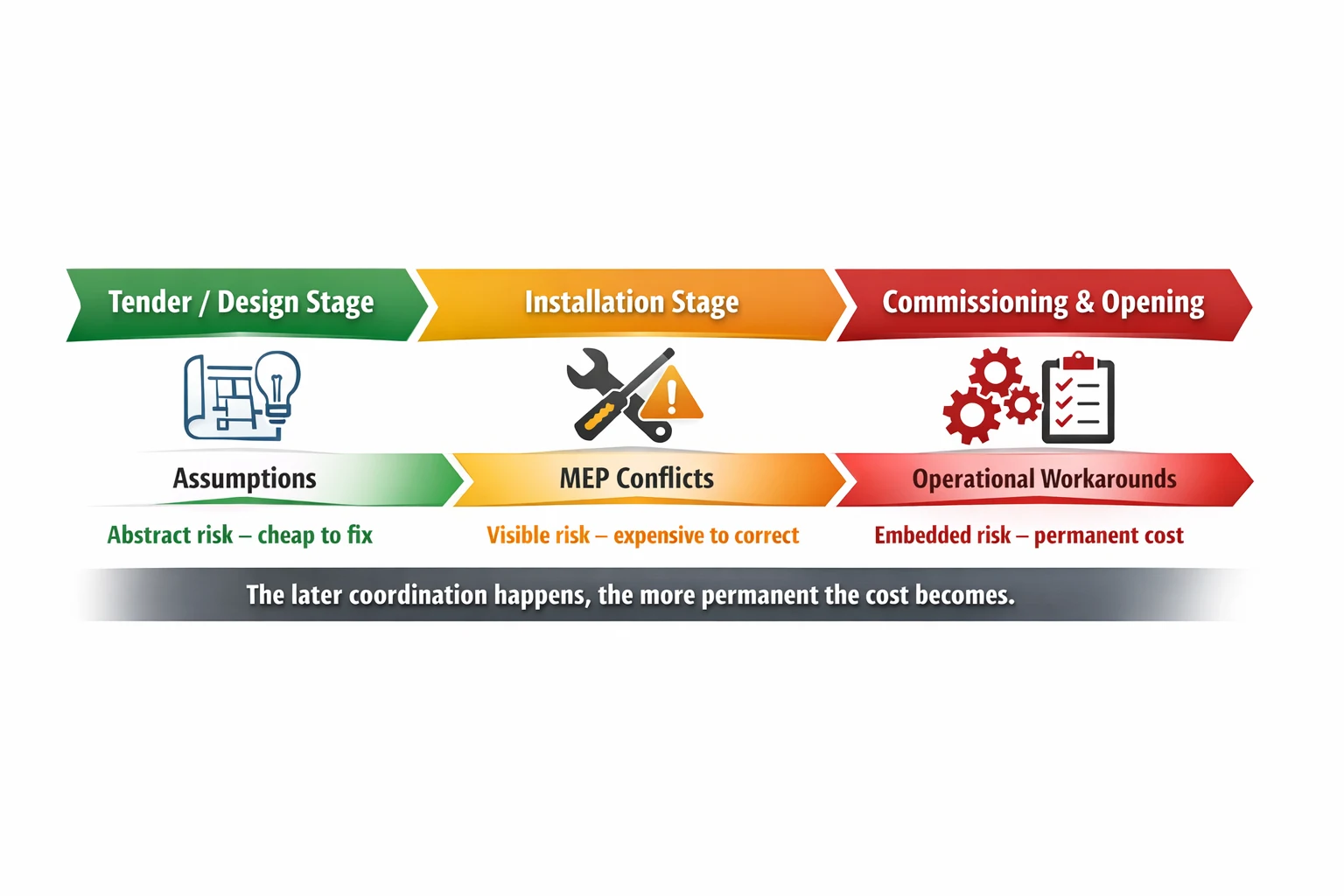
In commercial kitchen projects, installation delays are almost always a coordination problem, not a logistics problem. More specifically, they are an MEP coordination problem that surfaces too late — when decisions become expensive and flexibility is already lost.
Why Installation Delays Are Rarely Caused by Late Equipment Deliveries
Late deliveries are visible. Coordination failures are not.
When installation stalls, delivery schedules are usually blamed first. In reality, most delays occur with equipment already on site. Crews wait not for products, but for answers.
Clearances conflict. Penetrations are misaligned. Access routes overlap. Mechanical, electrical, and plumbing systems compete for the same physical space.
Delays are behavioral, not logistical.
They emerge when multiple systems arrive without a shared execution logic.
What MEP Coordination Really Means on a Live Construction Site
On drawings, MEP coordination appears complete.
Ducts are shown. Pipes are routed. Cable trays are placed. Each system fits — individually.
On site, all systems must fit together.
Ceiling voids compress. Structural elements interrupt routes. Installation sequences collide. A duct blocks access for cable pulling. A pipe prevents equipment anchoring.
MEP coordination is not about drawing alignment.
It is about installation order, access logic, and tolerance management under real conditions.
Where Installation Time Is Quietly Lost During Kitchen Installation
Time is rarely lost in large chunks.
It disappears in small adjustments.
Installers pause to wait for clarification. Systems are temporarily removed to allow others to pass. Crews return later to finish interrupted work.
Each interruption seems minor.
Together, they stretch installation schedules beyond recovery.
Most delays are not recorded as delays.
They are recorded as waiting.
The Real Cost of Solving MEP Conflicts During Installation
Resolving coordination issues during installation multiplies cost.
Resequencing crews creates idle time. Reinstalling systems consumes labor twice. Retesting becomes necessary when changes affect performance.
Most importantly, decisions are made under pressure.
What could have been solved on paper becomes a compromise on site.
Cost increases not because solutions are complex — but because timing is late.
MEP Coordination vs Installation Sequencing: Why Drawings Alone Fail
On paper, MEP coordination often looks complete.
Routes are defined, clashes are resolved, and approvals are issued.
What drawings cannot validate is installation order.
A system that fits spatially may still block access, prevent anchoring, or delay testing if installed at the wrong moment.
Most installation delays attributed to site conditions are in fact sequencing assumptions that were never tested.
Why Approved MEP Drawings Still Cause Installation Delays
Approved drawings confirm compliance — not installability.
They rarely answer practical questions:
- Which system must be installed first?
- Which access must remain open?
- When does closure eliminate future work?
Without sequencing validation, drawings push conflict to site.
Approval freezes design, but conflict emerges during execution.
True MEP coordination defines not only where systems go, but when they are installed, accessed, and closed.

Design-Stage MEP Coordination vs Site-Stage Conflict Resolution
Resolving MEP conflicts early and resolving them on site are not equivalent.
At design stage, decisions are flexible and reversible.
On site, the same decisions become compromises.
Design-stage coordination removes conflict.
Site-stage coordination absorbs it — at a cost.
This difference defines whether installation time is protected or eroded.
Why MEP Decisions Become Expensive Once Installation Starts
Once installation begins, every MEP adjustment multiplies impact.
Crews wait.
Completed work is removed.
Testing windows shift.
What could have been resolved through alignment becomes a time-driven negotiation.
Cost does not increase because solutions are complex.
It increases because timing is late.
The Invisible Installation Delays No Project Schedule Shows
Most installation delays never appear as red flags on schedules.
They appear as waiting. Crews pause for access. Teams return later to finish interrupted tasks. Small gaps form between activities and slowly stretch the timeline.
Most delays do not appear as delays.
They appear as waiting.
By the time the schedule reflects slippage, recovery is already difficult.
How MEP Coordination Delays Migrate Into Commissioning and Opening
Installation delays rarely stop at installation.
When MEP conflicts consume time on site, commissioning windows compress. Testing overlaps. Adjustments move closer to opening day.
Delays migrate forward — from construction into operation.
By opening, risk is no longer technical.
It becomes operational pressure.
Why Commissioning Windows Shrink After MEP Conflicts
Commissioning depends on uninterrupted time.
MEP conflicts steal that time quietly.
Systems are tested individually, then retested after adjustments.
Each retest shortens the margin for correction.
By opening, the kitchen functions — but not optimally.
BOQ and Responsibility Gaps That Predetermine MEP Delays
Many installation delays are locked in before construction begins.
BOQs often define quantities but avoid responsibility:
- “By others”
- “As required”
- “Coordinated on site”
These phrases defer decisions instead of resolving them.
When installation starts, unresolved scope gaps surface simultaneously — forcing coordination under pressure.
This is not a documentation error.
It is a timing error.
Why “By Others” Notes Create MEP Risk
“By others” does not remove responsibility.
It postpones it.
MEP interfaces without ownership default to site resolution.
That resolution is slower, costlier, and rarely optimal.
Undefined responsibility is not neutral.
It is risk deferred into execution.
The Turnkey Lens: How Coordinated MEP Planning Shortens Installation Time
A turnkey approach changes when coordination happens.
Instead of resolving conflicts during installation, systems are aligned earlier — when layout, equipment interfaces, and MEP routes are still flexible.
Manufacturing feedback informs real clearances. Installation sequencing is tested before crews arrive. Design assumptions are challenged against physical reality.
When manufacturing, layout planning, and MEP coordination operate within one responsibility structure, decisions are removed from site.
Selective integration of precision-driven European systems helps where tolerance is critical. Manufacturing-led execution allows faster correction cycles where adaptation is required.
Coordination before installation is cheaper than control during installation.
What a Delayed Commercial Kitchen Installation Looks Like in Practice
Schedules slide incrementally.
Trades overlap unexpectedly. Testing phases compress. Commissioning shifts closer to opening day.
Stress replaces planning.
Technically, the project is still viable.
Operationally, risk accumulates.
What Installation Delays Really Cost After Opening
Installation delays do not end at opening.
They translate into inefficient workflows, extended runtimes, and higher labor absorption.
What appears as a construction issue becomes operational behavior.
Why Delays That Look Technical Become Operational
Once a kitchen opens, technical flaws become human routines.
Staff adapts.
Workarounds normalize.
Delays that were never fully resolved stop being visible — but continue to generate cost daily.
Final Insight
Installation speed is not achieved by working faster on site.
It is achieved by removing decisions before installers arrive.
MEP coordination reduces delays not by perfection, but by timing — solving conflicts when they are still cheap.
FAQ – MEP Coordination and Installation Delays
Why do installations delay even when drawings are approved?
Because drawings confirm compliance, not installability under real sequencing and access conditions.
Is MEP coordination only a design responsibility?
No. It requires execution validation, sequencing logic, and site-aware decision ownership.
Can coordination issues be fixed during installation?
Yes — but at significantly higher cost and with cascading schedule impact.
Does turnkey delivery eliminate all delays?
No. But it concentrates coordination earlier, when change is cheaper and more controllable.
When should MEP coordination be finalized?
Before installation mobilization, while sequencing and access decisions are still flexible.