Why Energy Waste Starts After Installation — Not at Purchase
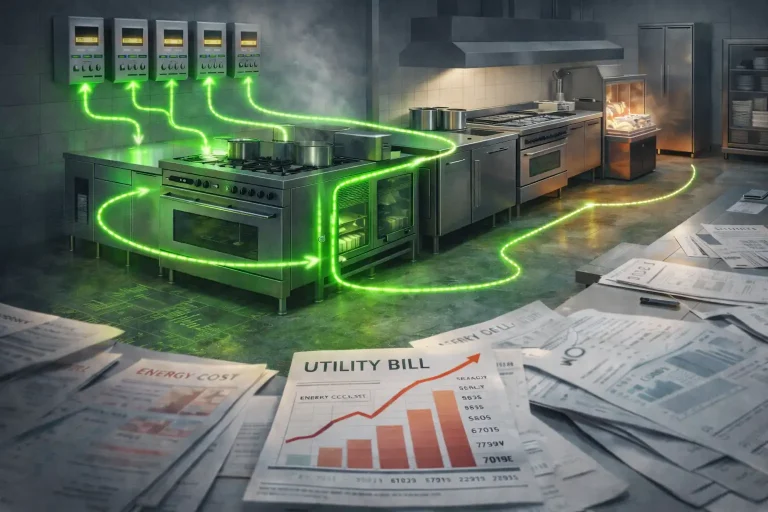
Most commercial kitchens do not waste energy when they are busy. They waste energy when they are idle — but still fully powered.
This is the hidden reality behind rising utility bills in hotels, resorts, and catering operations. Equipment is modern, branded, and fully compliant. Energy-efficient labels are in place. Yet operating costs continue to exceed projections.
Across large-scale commercial kitchen projects, the pattern is consistent: energy waste is not caused by inefficient equipment — it is caused by oversized equipment selected without real usage logic.
Right-sizing is not about buying cheaper or smaller machines. It is about aligning installed capacity with how the kitchen actually operates — hour by hour, not just at peak.
What “Right-Sizing” Really Means in Commercial Kitchens
Right-sizing is often misunderstood.
It does not mean:
- Reducing performance
- Limiting peak capability
- Compromising menu flexibility
Right-sizing means:
- Designing capacity around real utilization patterns
- Separating peak demand from permanent load
- Preventing energy draw during idle or partial-load operation
In financial terms:
Capacity defines what a kitchen can do. Utilization defines what a kitchen actually does.
Energy waste lives in the gap between the two.
Where Energy Waste Really Comes From
Energy loss in commercial kitchens rarely comes from a single appliance. It is systemic.
1️⃣ Oversized Cooking Equipment
Equipment is frequently sized for the absolute maximum theoretical output — not for real operating hours.
Result:
- High standby losses
- Partial-load inefficiency
- Energy draw continues even when production drops
2️⃣ Idle Load During Non-Peak Hours
Most hotel kitchens operate at:
- 100% load for short peak windows
- 40–60% load for most of the day
Yet equipment remains:
- Fully powered
- Fully heated
- Fully ventilated
Idle energy becomes invisible cost.
3️⃣ Ventilation & HVAC Chain Reaction
Oversized cooking lines trigger:
- Larger hoods
- Higher exhaust volume
- Increased make-up air
- Bigger HVAC compensation
One oversized appliance quietly inflates the entire energy ecosystem.
Micro Case 1 — Oversized Cooking Line, Underused Reality
Scenario: A 280-key business hotel designed its main kitchen for maximum banquet capacity.
Design intent:
- Peak banquet load: 700 covers
- All hot-line equipment sized accordingly
Operational reality:
- Large banquets occur 2–3 times per month
- Daily operation uses only 45–50% of installed cooking capacity
Observed impact:
- Cooking equipment remained powered for readiness
- Ventilation operated at near-maximum rates
- Energy consumption exceeded forecast by 22%
The kitchen never exceeded its design capacity. It exceeded its energy efficiency threshold.
Micro Case 2 — Partial Load That Still Consumes Full Energy
Scenario: A catering kitchen equipped for continuous high-volume production.
On paper:
- Correct equipment
- Approved electrical and gas loads
In reality:
- Production fluctuated heavily by time of day
- Equipment operated at 40–60% output for long periods
Observed impact:
- Energy draw remained close to 90–100%
- Cost per meal increased despite lower volume
The issue was not inefficiency. It was mismatch between load profile and equipment behavior.

Hidden Energy Waste Nobody Calculates
Most energy losses in commercial kitchens do not come from peak usage.
They come from everything that happens around the peak.
Energy waste is rarely caused by broken equipment.
It is caused by oversized systems operating outside of real demand logic.
The most common hidden energy losses we observe in right-sized kitchens that still consume too much energy:
- Idle running loss
Equipment selected for peak load often runs at partial capacity for long periods. The energy consumed during idle and standby modes frequently exceeds peak-hour consumption over a full operating day.
- Standby heat load on HVAC
Oversized cooking equipment continues to radiate heat even when not actively used. This heat forces ventilation and HVAC systems to work harder, increasing energy consumption outside service windows.
- Over-recovery cycles
Large equipment recovers faster than needed for real production flow. Frequent high-power recovery cycles occur even when demand does not require them, creating unnecessary electrical and gas peaks.
- Parallel equipment overlap
Multiple oversized units start and recover simultaneously during overlapping tasks. The problem is not total capacity — it is synchronized demand.
- Behavior-driven energy spikes
Staff adapts to oversized equipment by leaving units running “just in case.” These behavioral shortcuts silently increase energy use without improving performance.
Energy waste is not visible on drawings, BOQs, or equipment datasheets.
It appears only when real workflow behavior meets oversized capacity.
Assumption vs Reality – Energy Edition
Assumption: Bigger equipment provides safety and flexibility.
Reality: Bigger equipment increases idle loss and uncontrolled energy drift.
Assumption: Peak capacity defines energy performance.
Reality: Overlap timing and behavior density define energy performance.
Assumption: Energy efficiency is a specification issue.
Reality: Energy efficiency is a workflow and sequencing issue.
Assumption: Right-sizing is about reducing investment.
Reality: Right-sizing is about protecting operating cost stability.
Assumption: Energy waste appears during peak service.
Reality: Most energy waste happens before and after peak service.
Energy efficiency in commercial kitchens is not achieved by choosing “efficient” equipment.
It is achieved by matching capacity, behavior, and timing — not averages, not assumptions.
Right-Sizing vs Under-Sizing — The Critical Distinction
Right-sizing is not under-sizing.
Under-sizing creates:
- Service delays
- Quality loss
- Staff stress
Right-sizing creates:
- Full performance during peaks
- Reduced energy draw during idle periods
- Faster recovery after surges
The goal is not to shrink capacity — It is to control when full capacity is actually needed.
Energy Waste Is a System Problem — Not an Equipment Problem
Energy loss compounds across systems:
- Cooking equipment
- Ventilation
- HVAC
- Electrical infrastructure
An oversized fryer does not just waste gas or power. It increases:
- Hood size
- Exhaust volume
- Cooling demand
- Electrical peak load
Energy waste multiplies — silently.
Turnkey Perspective — Why Right-Sizing Must Be Engineered
In fragmented delivery models:
- Equipment is sized independently
- Ventilation follows appliance ratings
- HVAC compensates afterward
No one owns the energy behavior of the system.
In a turnkey mindset:
- Equipment capacity is aligned with workflow
- Ventilation adapts to real usage patterns
- Energy demand is engineered — not assumed
Right-sizing only works when one party owns the outcome, not just the supply.
Numeric Reference — Oversized vs Right-Sized Kitchens
Parameter | Oversized Kitchen | Right-Sized Kitchen |
Average utilization | 40–50% | 65–75% |
Idle energy loss | High | Controlled |
Annual energy cost | +15–25% | Optimized |
HVAC load | Inflated | Balanced |
ROI stability | Volatile | Predictable |
Final Insight
Energy-efficient equipment does not guarantee low energy cost.
Right-sizing does.
When capacity matches behavior, kitchens stop wasting energy — without losing performance.
FAQ – Right-Sizing & Energy Waste
Is right-sizing only about saving energy?
No. It also improves stability, maintenance cycles, and ROI predictability.
Can right-sizing affect peak performance?
No — if engineered correctly, peak capability is preserved.
Why is this rarely addressed during design?
Because average-day assumptions dominate early planning.
Who should request right-sizing validation?
Owners, investors, and operations leaders concerned with long-term operating cost.
Can existing kitchens be corrected?
Yes — but early intervention is far more cost-effective.