Why the Same Problem Becomes 5–8× More Expensive After Opening
The kitchen opens. Service begins. Guests arrive. Only then do small problems start to surface.
A landing zone is too tight. A drain struggles under real flow. Equipment recovery takes longer than expected. Staff adapts, supervisors intervene, and temporary fixes quietly become daily habits.
Nothing looks dramatic. But costs start accumulating.
Across hotel and resort kitchen projects, one reality repeats with uncomfortable consistency: the same design or workflow issue costs a fraction to fix before installation — and multiples more after opening.
This is not because the problem changes. It is because the context changes.
The Two Moments When Kitchens Can Be Fixed
Every kitchen issue appears twice:
- Before installation — when drawings, layouts, and sequencing can still change
- After opening — when operations, guests, and revenue are already in motion
Technically, both moments allow correction. Financially, they are not comparable.
Why Fixes After Opening Explode in Cost
Once a kitchen is operational, every correction triggers secondary impact:
- Service interruption or slowdown
- Staff rescheduling or overtime
- Temporary workarounds becoming habits
- Guest experience risk
- Management attention diverted to firefighting
At this stage, cost is no longer limited to labor and materials. It includes lost efficiency, lost reputation, and permanent operational inflation.
Key insight: The issue does not become more complex — it becomes more expensive because the kitchen is already alive.
Cost Multiplier by Project Phase (Execution Reality)
Project Phase | Typical Fix Type | Cost Multiplier | Why Cost Escalates |
Design phase | Drawing or logic adjustment | 1× | No physical work, no disruption |
Pre-installation | Layout or sequencing revision | 1.5–2× | Limited coordination impact |
During installation | Partial dismantling | 3–4× | Rework, delays, trade conflicts |
Post-opening | Operational retrofit | 5–8× | Downtime, staff cost, guest impact |
Key insight: Cost escalation is driven by timing, not technical difficulty.
Resort & Banquet Kitchens — Where the Cost Gap Widens
In resort and banquet-driven kitchens, post-opening fixes are especially costly because:
- Peak loads leave no buffer for experimentation
- Service failures are highly visible
- Temporary fixes often require additional staff
A layout friction that adds one extra person per shift may look minor. Over a year, it becomes a permanent labor cost line.
Issues That Are Cheap Before — Expensive After
The most common examples we see:
- Undersized landing zones
- Drainage slopes that fail under real flow
- Access blocked for cleaning or maintenance
- Workflow crossings during peak service
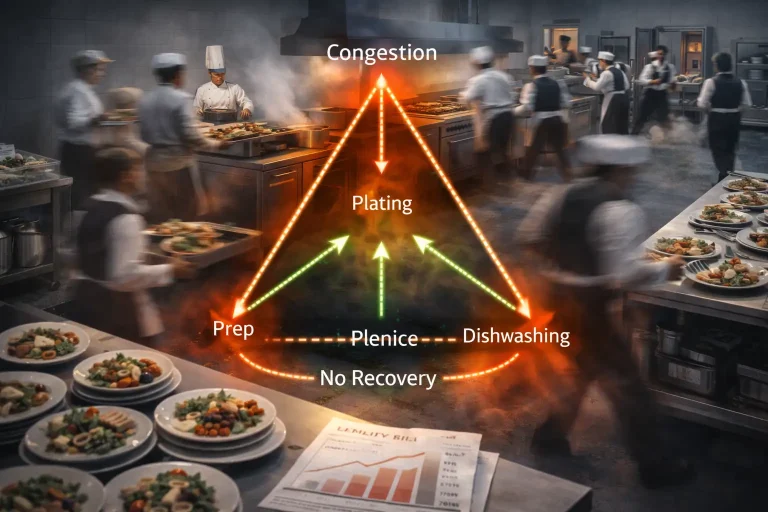
- Recovery cycles overlapping preparation
All of these are design-execution issues, not equipment failures.

What Actually Gets More Expensive After Opening (The Hidden Layer)
When kitchens are fixed after opening, the most expensive items are rarely construction or equipment.
What truly escalates:
- Permanent labor increases to compensate for layout friction
- Supervisor and management overhead to stabilize unstable workflows
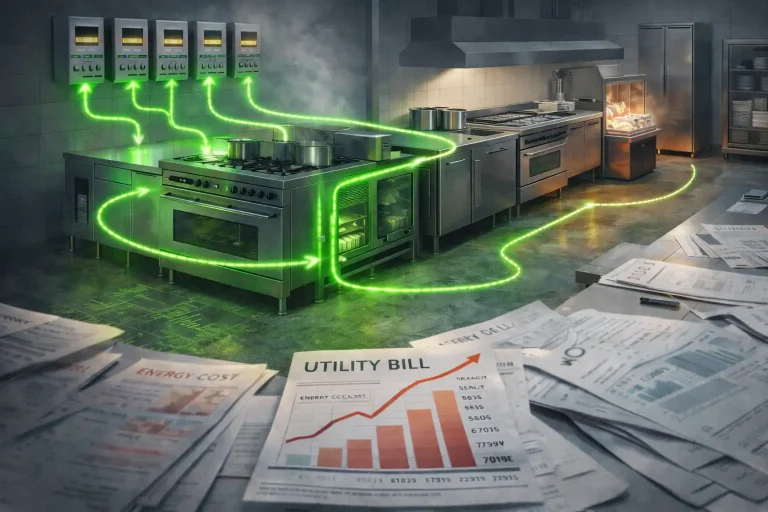
- Energy penalties from over-ventilation and extended run times
- Guest experience costs (complaints, comps, reputation erosion)
- Maintenance workarounds that become standard operating behavior
These costs do not appear on BOQs. They appear quietly on monthly P&Ls.
Key insight: Post-opening fixes inflate OPEX — and OPEX never stops.
Post-Opening Fixes That Rarely Pay Back
Some corrections feel effective in the short term but permanently damage efficiency:
- Adding extra staff instead of removing congestion
- Splitting shifts unnaturally to avoid peak collisions
- Over-ventilating to mask heat caused by layout errors
- Manual task sequencing to compensate for missing buffer zones
These solutions stabilize service temporarily — but they lock inefficiency into daily operations.
Key insight: Solutions that rely on people adapting instead of systems correcting rarely deliver ROI.
Mini ROI Scenario — Same Kitchen, Two Timelines
Scenario A – Issue Fixed Before Installation
- Opening delay: +3 days
- Additional cost: €12,000
- Outcome: Stable workflow from day one
Scenario B – Issue Fixed After Opening
- No initial delay
- First 60 days:
- +2 permanent staff
- Increased energy consumption
- Slower service recovery
- 12-month hidden cost: €180,000+
Key insight: Avoiding a short delay often creates a long-term cost trap.
Why Owners Underestimate Post-Opening Fix Costs
This pattern is not technical — it is psychological.
Common drivers:
- Sunk cost fallacy: “We’ve already invested this much.”
- Opening pressure: Marketing, staffing, and bookings are already live
- Blame shifting: Issues are labeled operational instead of structural
- Short-term bias: Temporary fixes feel cheaper than delays
These forces push teams to open fast — and pay slowly, every day afterward.
Turnkey Lens — Where Cost Is Actually Locked
In commercial kitchen projects, cost is not locked at procurement. It is locked before installation begins.
Once a kitchen opens:
- Layout inefficiencies become labor costs
- Timing issues become energy waste
- Design gaps become behavioral workarounds
A turnkey mindset does not aim for lower CAPEX. It aims to prevent irreversible OPEX inflation.
Final Insight
Kitchens are not expensive to fix because they are complex. They are expensive to fix because problems are allowed to survive until the kitchen starts earning money.
The smartest cost control strategy in kitchen projects is not value engineering. It is early, execution-focused correction.
FAQ – Fixing Kitchens Before vs After Opening
Why are post-opening fixes so expensive?
Because every change affects service, staff, and guest experience simultaneously.
Can all problems be fixed before installation?
Most workflow, layout, and access issues can — if they are actively looked for.
Is it sometimes better to wait until after opening?
Only for fine-tuning. Structural issues always cost less before installation.
Who should request early layout and workflow review?
Owners, GMs, and project managers — before installation begins.
What is the biggest hidden cost of post-opening fixes?
Permanent labor increase caused by inefficient layouts.