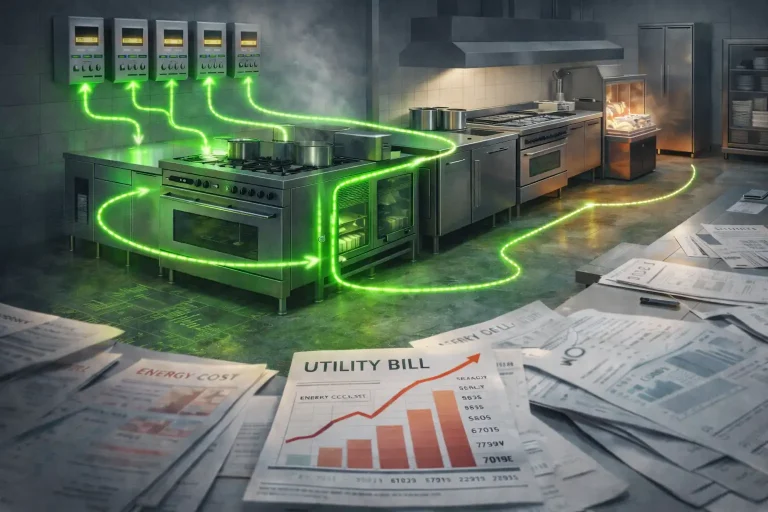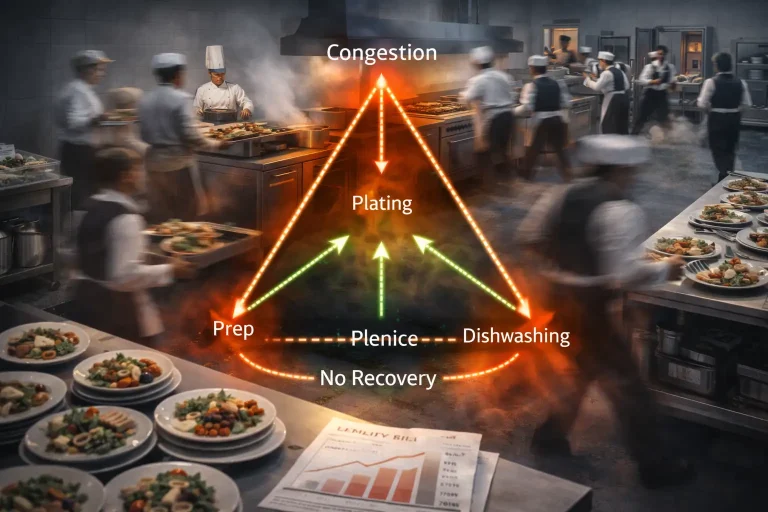
Tender documents look complete.
Scopes are defined. Prices are aligned. Timelines are approved. Everyone signs with confidence.
Then the project starts.
And the real risks — the ones that never appear in tenders — begin to surface.
Across hundreds of commercial kitchen projects, the same pattern repeats:
risk does not disappear at tender stage — it relocates.
In commercial kitchen projects, the most damaging risks are not hidden because they are complex.
They are hidden because they are uncomfortable to quantify, difficult to assign, and inconvenient to own.
These risks do not live in specifications.
They live in interfaces, assumptions, and behavior under pressure.
Why Commercial Kitchen Tender Documents Create a False Sense of Security
Tenders are designed to compare.
They standardize scope, pricing, and delivery timelines so decisions can be made efficiently.
This structure is useful — but incomplete.
What tenders do not capture is behavior under pressure.
They describe what should be delivered, but rarely how the project will behave once installation starts and time pressure arrives.
A kitchen that looks identical on paper can behave very differently once sequencing tightens, trades overlap, and commissioning windows compress.
Risk does not disappear because it is not written down.
It simply waits for the moment when assumptions meet reality.
Risk #1: Interface Responsibility Gaps in Commercial Kitchen Projects
Why Interface Ownership Fails in Commercial Kitchen Tenders
Zero‑click answer: Interface risk emerges when responsibility between systems is undefined, forcing late site decisions that permanently reshape kitchen performance.
This is rarely a technical failure. It is an ownership failure.
Tender documents list equipment.
They rarely define who owns the interfaces between systems.
Ventilation meets cooking.
Drainage meets floor slope.
Electrical supply meets control logic.
Each interface sits between scopes — and therefore between responsibilities.
When these interfaces are undefined, coordination defaults to site improvisation.
Decisions are made late, under pressure, and often by the party with the least authority to redesign.
In projects where interface authority is fragmented, risk concentrates at site level.
Integrated execution structures tend to resolve these interfaces earlier — before site pressure forces compromise.
Risk #2: Installation Sequencing Assumptions That Derail Kitchen Projects
Why Installation Sequencing Breaks Down on Real Kitchen Sites
Zero‑click answer: Sequencing risk occurs when tender‑stage assumptions are never tested against real site constraints, causing delay without technical error.
Sequencing issues are not caused by bad planning — but by untested assumptions.
Most tenders assume a logical installation sequence.
They rarely test whether that sequence is executable on the actual site.
Ceiling works overlap with hood installation.
Floor finishes collide with drain positioning.
Equipment arrives before access paths are ready.
Each assumption looks reasonable in isolation.
Together, they create delay without anyone technically being wrong.
Sequencing risk is invisible on paper — yet it is one of the fastest cost multipliers on site.
Projects where sequencing authority, technical clarification, and site coordination sit closer together correct these clashes earlier — while change is still cheap.
Risk #3: BOQ Accuracy Without Behavioral Validation in Kitchen Tenders
Why BOQ Accuracy Alone Does Not Prevent Operational Risk
Zero‑click answer: A BOQ can be correct on paper yet fail operationally when clearances, access, and combined behavior are not validated early.
A BOQ can be numerically correct and still be operationally risky.
Quantities may match drawings, yet ignore:
- Installation tolerances
- Service access needs
- Maintenance clearances
What is accurate in isolation may fail in combination.
This is not a BOQ error.
It is a behavioral blind spot — where numbers are right, but usage is misunderstood.
In execution models where manufacturing input, technical clarification, and installation feedback sit closer together, BOQ behavior stabilizes earlier — not because numbers change, but because uncertainty is resolved sooner.
Risk #4: Commissioning Assumptions That Break Under Live Kitchen Operation
Why Kitchen Commissioning Risk Appears After Handover
Zero‑click answer: Commissioning risk surfaces when systems are tested individually but never validated under simultaneous live‑operation conditions.
Tenders often treat commissioning as a checkbox.
Systems are tested individually, signed off, and handed over.
What is rarely tested is simultaneous system behavior.
Under live conditions, systems interact.
Air volumes change with load.
Drainage reacts to peak discharge.
Controls respond to human intervention, not ideal sequences.
A kitchen that commissions cleanly can still destabilize during peak operation — when everything runs at once.
Commissioning risk reduces significantly when technical authority remains close to execution beyond handover.
Risk #5: Post-Opening Performance Drift in Commercial Kitchens
Why Post‑Opening Performance Risk Is Missing From Tenders
Zero‑click answer: Post‑opening risk emerges as staff adapt to unresolved friction, converting design gaps into permanent operating cost.
Tender risk assessment usually ends at handover.
But kitchens do not generate value at handover.
They generate value during daily operation.
Performance drift begins when staff adapts to unresolved friction.
Workarounds become routine.
Extra movement becomes normalized.
Labor absorbs what design and sequencing did not resolve.
This risk never appears in tenders — yet it defines long-term operating cost.
Projects with integrated technical ownership correct early operational friction faster — before inefficiencies harden into permanent behavior.
Tender Risk vs Operational Risk in Commercial Kitchen Projects
Tender-stage risk and operational risk are not the same thing.
One is visible, comparable, and contractual.
The other emerges through behavior, timing, and system interaction.
Tender Risk vs Operational Risk – Structural Comparison (Commercial Kitchens)
Aspect | Tender Risk | Operational Risk |
Visibility | Clearly listed | Emerges over time |
Ownership | Contract-defined | Behavior-driven |
Timing | Pre-contract | Post-installation |
Control method | Price & scope | Coordination & execution |
Financial impact | Predictable | Compounding |
What looks manageable at tender stage becomes dominant at operational scale.
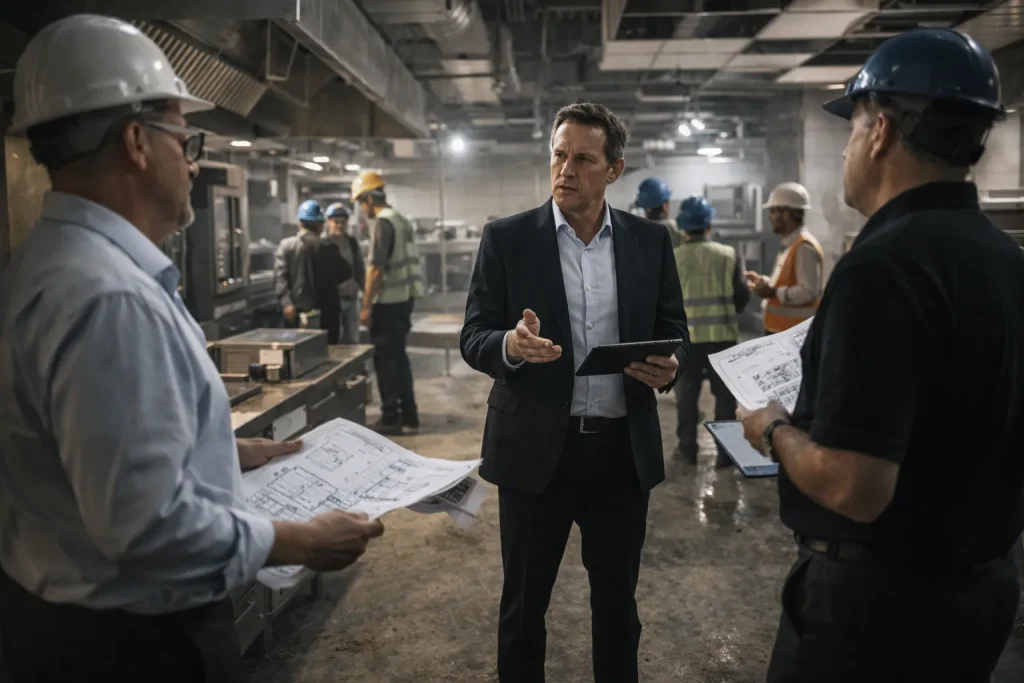
How Risk Migrates From Tender Stage to Kitchen Operation
Conceptual visual placeholder: Risk Migration Curve – From Tender Assumptions to Operational Behavior
(Illustration idea: risk starts abstract at tender, materializes during installation, and becomes permanent cost during operation.)
Risk does not disappear after contracts are signed.
It migrates.
Tender → Installation → Operation
During tender stage, risk appears controllable and abstract.
During installation, it materializes through interfaces and sequencing.
During operation, it becomes permanent behavior embedded in workflows and staffing patterns.
The later risk is addressed, the less controllable it becomes — and the more expensive correction grows.
Designing Operational Risk Out Before the Kitchen Tender Stage
How Early Project Structuring Reduces Kitchen Risk Exposure
The safest projects do not manage risk later.
They remove it early.
This requires validating:
- Interfaces, not just equipment
- Sequencing, not just timelines
- System interaction, not just compliance
Risk control begins before prices are compared — not after contracts are signed.
Why These Hidden Kitchen Project Risks Matter Before Contracts Are Signed
Once contracts are signed, risk becomes reactive.
Flexibility decreases.
Ownership fragments.
Correction becomes expensive.
Tender documents compare price.
Project structures determine behavior.
Integrated execution models do not eliminate risk —
they decide when and where it becomes visible.
Executive Takeaway
The most expensive kitchen project risks are not the ones left unpriced in tenders — they are the ones left structurally unresolved. When interfaces, sequencing, and behavioral assumptions are not owned early, risk migrates downstream and hardens into operating cost. Project outcomes are shaped less by what is specified, and more by when risk is confronted.
FAQ – Hidden Risks in Commercial Kitchen Tenders
Why do commercial kitchen tenders fail to capture the most expensive risks?
Because tenders are designed to compare scope and price, not to test behavior under installation and operational pressure. Risks that cannot be standardized are often deferred rather than resolved.
Can a detailed BOQ eliminate operational risk in kitchen projects?
No. A BOQ can be numerically accurate yet operationally unstable if interfaces, clearances, and combined system behavior are not validated early.
Which kitchen project risks grow fastest after contract signing?
Interface ownership gaps, sequencing assumptions, and commissioning behavior tend to compound rapidly once site pressure begins.
Why do some kitchen projects look stable at tender stage but fail during operation?
Because tender-stage stability measures contractual clarity, while operational success depends on how systems interact under live conditions.
How can project teams reduce hidden kitchen risks before tenders are issued?
By validating interfaces, sequencing, and system interaction upfront — before price comparison locks behavioral assumptions into contracts.