Why Power Problems Appear Only When the Kitchen Is Busy
“Nothing tripped during testing. Everything tripped during service.”
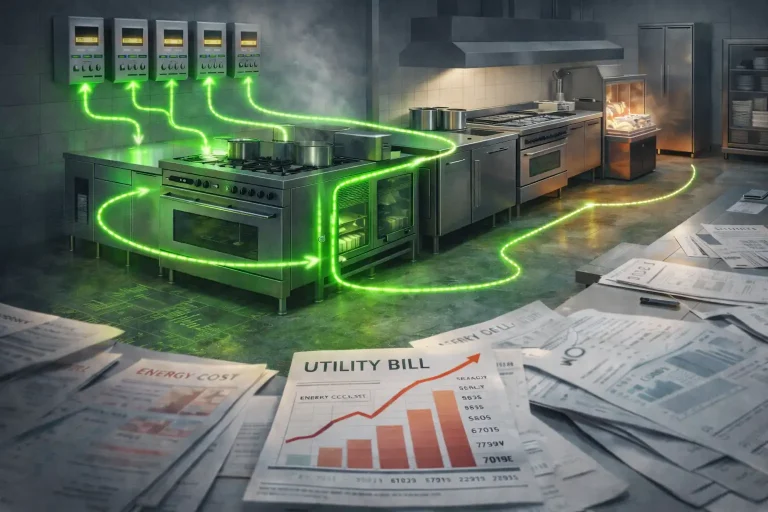
During factory tests, commissioning, and even soft openings, hotel kitchens often appear electrically stable. Equipment runs. Panels stay silent. Numbers look correct.
Then the first real service arrives.
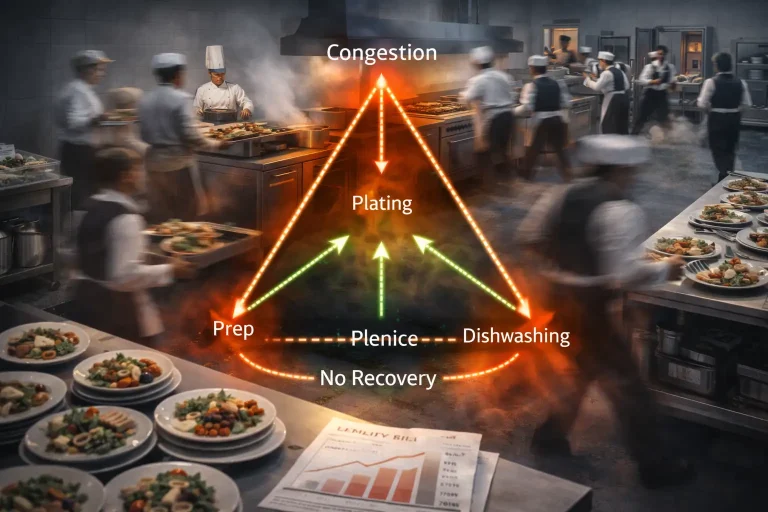
A banquet overlaps with à la carte. Recovery cycles start while ventilation ramps up. Dishwashers, combi ovens, holding cabinets, and extraction systems demand power at the same time.
Nothing is technically broken. Yet breakers trip, voltage drops, equipment throttles itself, and service rhythm collapses.
In modern hotel kitchens, electrical failure is rarely about missing capacity. It is about how electrical demand behaves under pressure.
Assumption vs Reality — Electrical Edition
Design assumption: If the total connected load is below installed capacity, the system is safe.
Operational reality: Kitchens do not consume power evenly. They consume power in collisions.
Approved electrical drawings confirm:
- Installed capacity
- Circuit distribution
- Compliance with standards
They do not confirm:
- Simultaneous equipment demand
- Recovery load stacking
- Behavioral peaks created by service pressure
Electrical stability is not defined by totals. It is defined by timing.
Why Electrical Load Planning Fails in Hotel Kitchens
Across large hospitality projects, electrical issues repeat for the same reasons:
- Total load is confused with simultaneous load
Equipment lists add up nicely on paper. Real kitchens switch on together. - Recovery load is ignored
After service, equipment does not rest. It recovers — aggressively. - Kitchen load is planned in isolation
The kitchen is treated as a subsystem, while the building reacts as a whole.
Each mistake is small on its own. Together, they destabilize service.
Micro Case 1 — Simultaneous Peak Collision (Service-Time Load)
Scenario: Business hotel banquet service.
During a 15-minute plating window:
- Combi ovens reach maximum output
- Holding cabinets draw continuous load
- Dishwashers restart full cycles
- Ventilation systems ramp to peak extraction
On paper:
- Installed power is sufficient
- Panels are correctly sized
- No single device exceeds rating
In reality:
- Multiple high-load devices peak simultaneously
- Voltage drops under transient demand
- Control boards limit performance to protect themselves
Outcome: Service slows without any visible electrical failure.
Key insight:
The kitchen did not exceed capacity. It exceeded simultaneity tolerance.
Micro Case 2 — Recovery Load Trap (Post-Service Peak)
Scenario: Resort kitchen after dinner service.
Service ends. Management relaxes. Then recovery begins:
- Combi ovens start cleaning cycles
- Dishwashers heat tanks simultaneously
- Hot water systems recharge
- HVAC shifts from extraction to recovery mode
This moment is rarely planned.
Observed result:
- Breakers trip after service
- Equipment restarts are delayed
- Morning prep begins with partially unavailable systems
Key insight:
Kitchens often fail electrically when everyone assumes the risk is over.
Typical Electrical Conflict Zones in Hotel Kitchens
In modern hotel kitchens, electrical failures rarely occur because total installed load was underestimated. They occur because simultaneity and recovery behavior were never mapped.
The most common electrical conflict zones we observe are:
- Cooking Line Clusters
High‑power equipment (combi ovens, fryers, bratt pans, induction ranges) concentrated on a single line often reaches peak demand simultaneously during service compression. Individually compliant equipment becomes collectively unstable. - Dishwashing & Pot‑Wash Overlap
During peak service, dishwashers, pot‑wash machines, heat recovery units, and booster heaters cycle together. These loads are rarely synchronized in design assumptions. - Bakery & Production Kitchens
Deck ovens, proofers, blast chillers, and mixers frequently overlap during early morning and pre‑service windows, creating recovery stress on electrical panels. - Back‑of‑House Support Loads
Cold rooms, ice machines, ventilation make‑up air units, and exhaust systems are often treated as background loads, yet they draw peak power exactly when cooking demand spikes. - Show Kitchens & Open Stations
Aesthetic design often overrides electrical zoning. Decorative layouts hide the fact that multiple high‑load devices are fed from limited distribution capacity.
Key insight: Electrical failures are rarely about total kW. They are about when loads collide.

Why Electrical Issues Often Look Like Staff Errors
When electrical systems struggle, the first symptoms rarely look technical. They appear human.
Typical misdiagnoses include:
- “Staff is slow today.”
- “Chefs are not coordinating.”
- “Service timing is off.”
- “Training needs improvement.”
In reality, these behaviors often emerge after electrical instability begins.
What actually happens:
- Equipment recovery time increases after power dips
- Cooking cycles stretch unpredictably
- Ventilation response lags behind heat generation
- Staff waits, adapts, or works around delays
Human behavior changes because the system becomes unreliable.
Chefs hesitate to load equipment simultaneously. Operators stagger tasks informally. Supervisors intervene more frequently.
Nothing is visibly broken. Yet efficiency collapses.
This is why electrical design errors are dangerous:
They disguise themselves as operational problems.
Key insight: When people slow down, it is often the system asking for mercy.
Average Load vs Peak Load vs Recovery Load
Load Type | When It Happens | Why It Is Missed |
Average Load | Normal service | Comfortable assumptions |
Peak Load | Plating & overlap | Simultaneity ignored |
Recovery Load | After service | “Service is finished” illusion |
Designs that only survive average load are fragile by definition.
Why Approved Electrical Drawings Still Fail
Electrical drawings validate capacity and compliance. They do not simulate behavior.
Drawings cannot show:
- Which equipment peaks together
- How staff triggers overlapping cycles
- How recovery demand stacks invisibly
As a result, kitchens pass approval — and fail under pressure.
Electrical problems appear operational, but their origin is structural.
Turnkey Perspective — Electrical Load Must Be Owned
Electrical performance sits between disciplines:
- Equipment specification
- Layout planning
- Workflow design
- Human behavior
When responsibility is fragmented, no one owns the moment when everything turns on together.
A turnkey mindset does not stop at compliance. It owns how the kitchen behaves when demand is highest.
What an Electrically Stable Kitchen Actually Looks Like
Electrically resilient kitchens share measurable traits:
- No breaker trips during the worst 30 minutes of service
- Stable voltage during simultaneous recovery cycles
- No manual load shedding by staff
When these conditions are met:
- Equipment performs consistently
- Staff confidence increases
- Management stops firefighting
The installed power may stay the same. The system behavior changes.
Final Insight
Electrical planning is not about how much power a kitchen has.
It is about when and how power is demanded.
Kitchens that survive their peak and recovery moments operate calmly the rest of the day.
FAQ – Electrical Load Planning in Hotel Kitchens
Is electrical failure usually caused by undersized panels?
Rarely. It is more often caused by unplanned simultaneity.
Can adding more capacity solve the problem?
Not always. Without behavioral planning, added capacity can still fail.
Why don’t tests reveal these issues?
Because tests rarely replicate real pressure and overlap.
Can existing kitchens be stabilized electrically?
Yes — through load sequencing, workflow adjustment, and selective upgrades.
Who should request electrical load validation?
Procurement teams, project managers, and operations leaders — before opening.