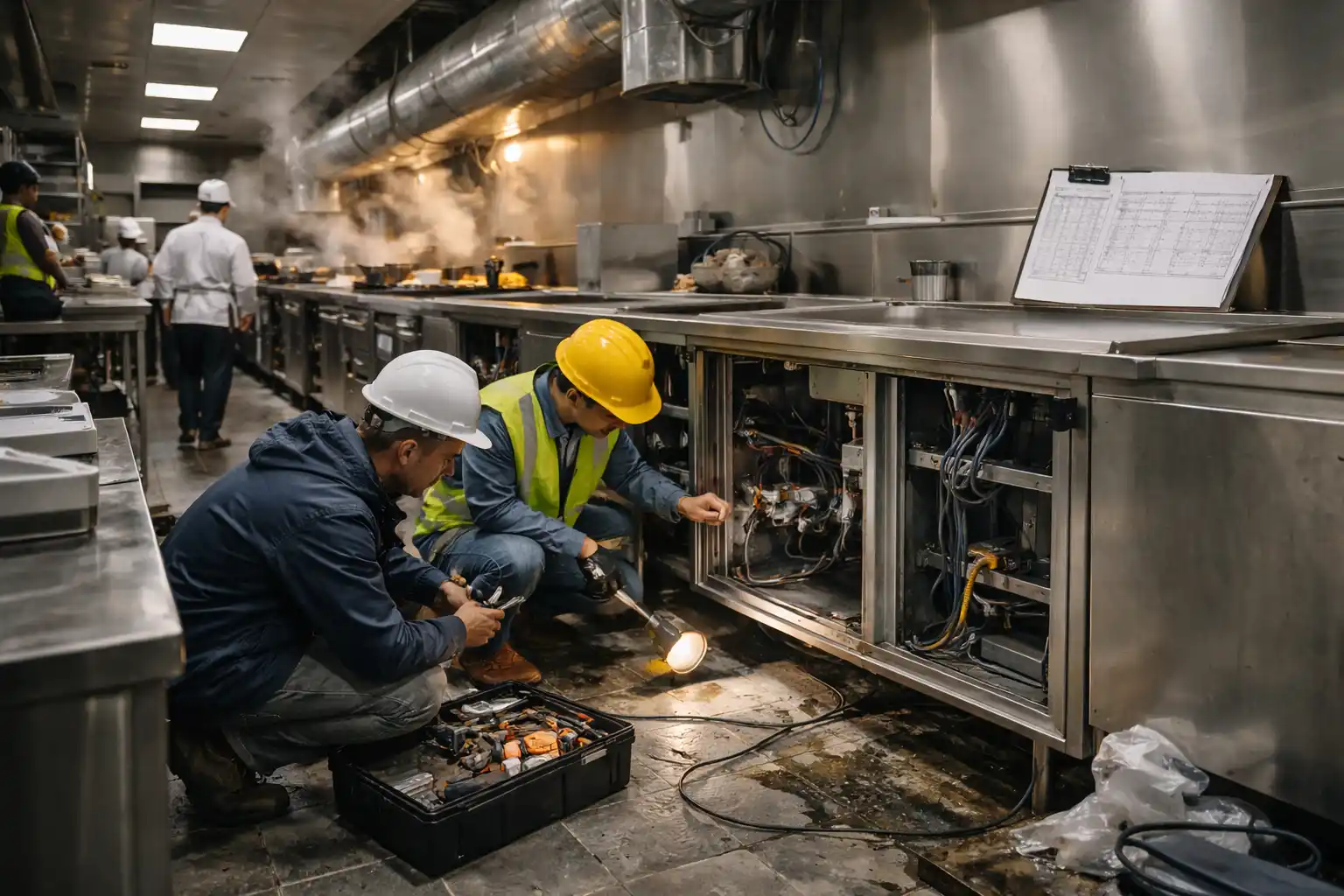
Assumption vs Reality in Commercial Kitchen Installation
Design assumption: Once drawings are approved, installation will follow smoothly.
Site reality: Installation slows down, rework begins, commissioning is delayed, and opening dates slip — even though every drawing was signed.
Across turnkey kitchen projects in Africa, the Middle East, and Europe, this pattern repeats itself with surprising consistency. Drawings pass consultant review, MEP approvals are issued, coordination meetings close clean — yet once installation starts, problems surface that no drawing set ever showed. The issue is rarely poor design quality. It is the gap between approved drawings and installation reality.
In commercial kitchens, drawings confirm intent. Installation exposes behavior.
Approved Drawings Validate Compliance — Not Installation Reality
Approved drawings answer only one question: “Is this design acceptable on paper?”
They do not answer:
- Can this equipment be positioned within real site tolerances?
- Can trades work in the planned sequence without blocking each other?
- Can services be connected without re-routing on site?
- Can commissioning occur without partial dismantling?
Consultant drawings define intent and compliance — not constructability. Shop drawings begin to expose manufacturer-specific dimensions and clashes. As-built reality introduces walls, slopes, levels, access limits, and sequencing constraints.
Projects fail when approved drawings are treated as execution tools instead of coordination starting points.
Where Installations Break Down (By Project Phase)
Approved drawings alone do not fail projects — timing does. Installation problems appear at predictable phases, yet teams rarely anticipate them.
Pre-Delivery Phase Risks
- BOQ mismatches between drawings and ordered equipment
- MEP capacities approved without real equipment load validation
- Missing coordination between layout and delivery sequencing
Impact: Issues discovered here multiply downstream costs by 3–5× once installation starts.
Installation Week Risks
- Equipment footprints not matching site tolerances
- Ducting and services clashing with beams or ceiling levels
- Late changes forced on site to “make it fit”
Commissioning Phase Risks
- Systems tested individually, not under full workflow load
- Ventilation, power, and gas never stressed simultaneously
First 30 Days of Operation
- Staff fatigue and slowdowns
- Temporary fixes becoming permanent inefficiencies
Key takeaway: Installation failure is rarely a single mistake — it is a phase-by-phase accumulation of unchecked risks.
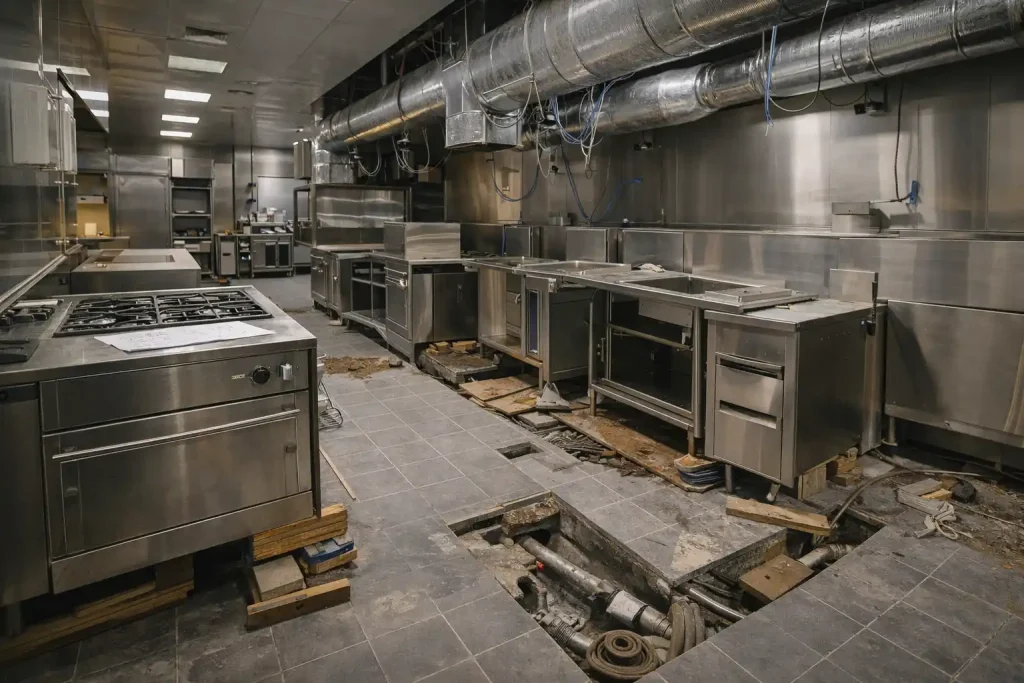
Where Kitchen Installations Actually Fail
The 5 Core Failure Zones
1️⃣ Coordination Gaps Between Trades
Drawings assume ideal sequencing. On site, electrical, mechanical, ventilation, and equipment teams overlap.
Result:
- Equipment placed before final service routes are ready
- Temporary fixes become permanent
- Commissioning postponed until after opening
This is not a workmanship issue — it is sequencing blindness.
2️⃣ MEP Interface Conflicts
Approved MEP drawings rarely reflect final equipment tolerances.
Typical failures:
- Gas points misaligned with appliance valves
- Drain slopes clashing with leveling feet
- Electrical panels inaccessible after equipment placement
Each correction affects multiple systems.
3️⃣ Tolerance & Leveling Assumptions
Drawings assume flat floors and square walls.
Site reality:
- Floors vary ±10–20 mm
- Walls are rarely perfectly aligned
- Drain slopes compete with leveling requirements
Consequences:
- Unsafe fryer operation
- Uneven cooking
- HACCP non-compliance
- Rework during inspection
4️⃣ Missing Installation Sequencing Logic
Drawings show where equipment goes — not how it gets there.
Common oversights:
- Heavy equipment installed before ceiling services
- Ducting blocking maintenance access
- Fixed equipment preventing final connections
By the time this is discovered, dismantling is often the only option.
5️⃣ Commissioning Assumptions
Commissioning is treated as a checklist.
Reality:
- Equipment tested individually
- Load conditions simulated, not real
- System interdependencies ignored
Failures appear during live service — when correction costs peak.
The Real Cost of Installation Failure
Issue | Typical Impact |
Rework during installation | 2–3× original installation cost |
Post-opening corrections | 3–5× design-stage correction cost |
Installation delay | 2–4 weeks average |
Missed opening window | $50k–$150k+ revenue loss |
Approved drawings reduce design risk. They do nothing to reduce installation risk.
Who Gets Hurt When Installation Fails?
- Owners: Delayed opening and lost revenue
- Operators: Unstable service and staff burnout
- Consultants: Reputation risk after handover
- Contractors: Disputes, variations, unpaid claims
Installation failure is not technical — it is organizational.
What Turnkey Contractors Control That Others Don’t
Turnkey-controlled elements:
- Installation sequencing aligned with workflow
- Single responsibility for layout, MEP, and equipment
- Coordinated commissioning under real service load
Multi-supplier gaps:
- Fragmented responsibility
- Problems surface after handover
Installation success is not about better drawings — it is about controlling the transition from paper to operation in a commercial kitchen installation environment.
Turnkey vs Fragmented Installation Responsibility
Topic | Turnkey Model | Multi-Supplier Model |
Coordination ownership | Single point | Distributed |
Installation sequencing | Planned early | Discovered on site |
Rework responsibility | Clear | Disputed |
Commissioning outcome | Predictable | Trial-and-error |
Opening risk | Controlled | Exposed |
Regional Installation Reality Check
Africa – Tolerance & Infrastructure Reality
In many African hotel projects, floor accuracy, power stability, and site readiness vary significantly from drawing assumptions. Installation sequencing must adapt in real time, not rely on ideal tolerances.
Lesson: Robust sequencing beats perfect drawings.
Middle East – Speed & Scale Pressure
Large-scale hotel and banquet kitchens are installed under aggressive timelines with multiple trades working in parallel. Even small sequencing errors multiply rapidly under scale and time pressure.
Lesson: Sequencing control defines success.
Europe – Retrofit & Constraint Dominance
Most projects involve existing structures, limited access, and strict regulatory constraints. Installation feasibility and service access often override layout elegance.
Lesson: Installation feasibility beats visual optimization.
Installation Is Not a Phase — It Is a System
Kitchen installation directly impacts ventilation performance, workflow continuity, commissioning stability, and long-term maintenance access. Installation failures often appear together with ventilation breakdowns and workflow bottlenecks — symptoms of the same coordination gap.
External Industry Insight
Independent hospitality construction studies consistently show that correcting installation-related issues after kitchen opening costs three to five times more than resolving coordination and sequencing risks during design and pre-installation — especially in large hotel and banquet kitchens.
Final Insight
Approved drawings do not fail kitchens.
Treating drawings as installation instructions does.
This is why installation logic must be engineered — not assumed.
FAQ – Kitchen Installation Reality
When should installation logic be addressed?
During layout finalization, not after drawing approval.
Can approved drawings guarantee smooth installation?
No. They confirm compliance, not constructability.
Why do installation issues appear late?
Because sequencing and tolerance conflicts are invisible on drawings.
How do turnkey projects reduce installation failure?
By engineering layout, MEP, equipment, sequencing, and commissioning as one system.